
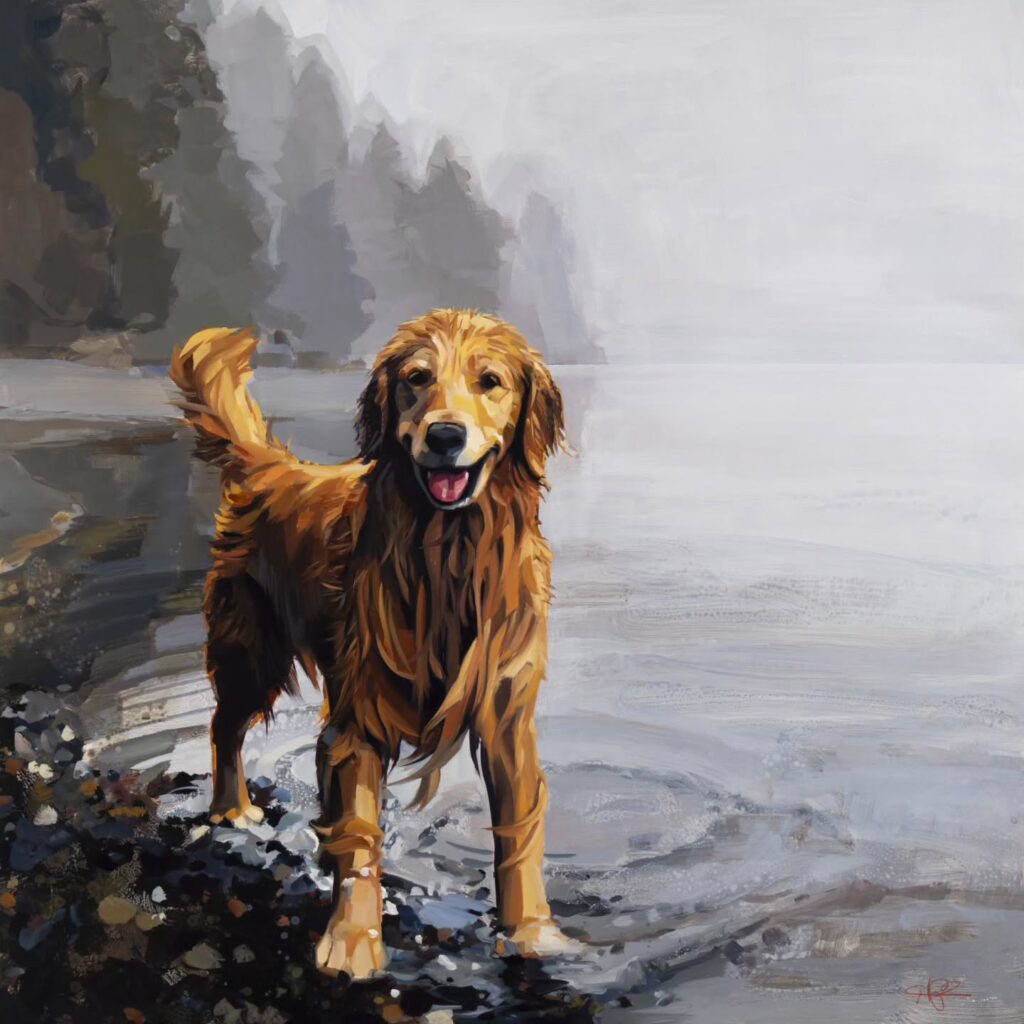
Your living room rug has a muddy paw print the size of Texas on it. Again.
Look, I get it. You love your golden retriever more than most people in your life — but your home décor tells a completely different story right now. It’s not the dog that’s the problem. It’s that nothing in your space actually celebrates him the way he deserves.
That’s where dog painting ideas come in, and honestly? This is where things get fun.
Last fall, I commissioned a small portrait of my dog and hung it above my bookshelf. Three people asked me where I bought it within a week. Your space can feel curated and personal at the same time — it doesn’t have to choose.
These 10 dog painting ideas will help you turn your pup into the Pinterest-worthy focal point your home has been missing.
#1: Fluffy White Dog Portrait Painting on Dark Blue Canvas
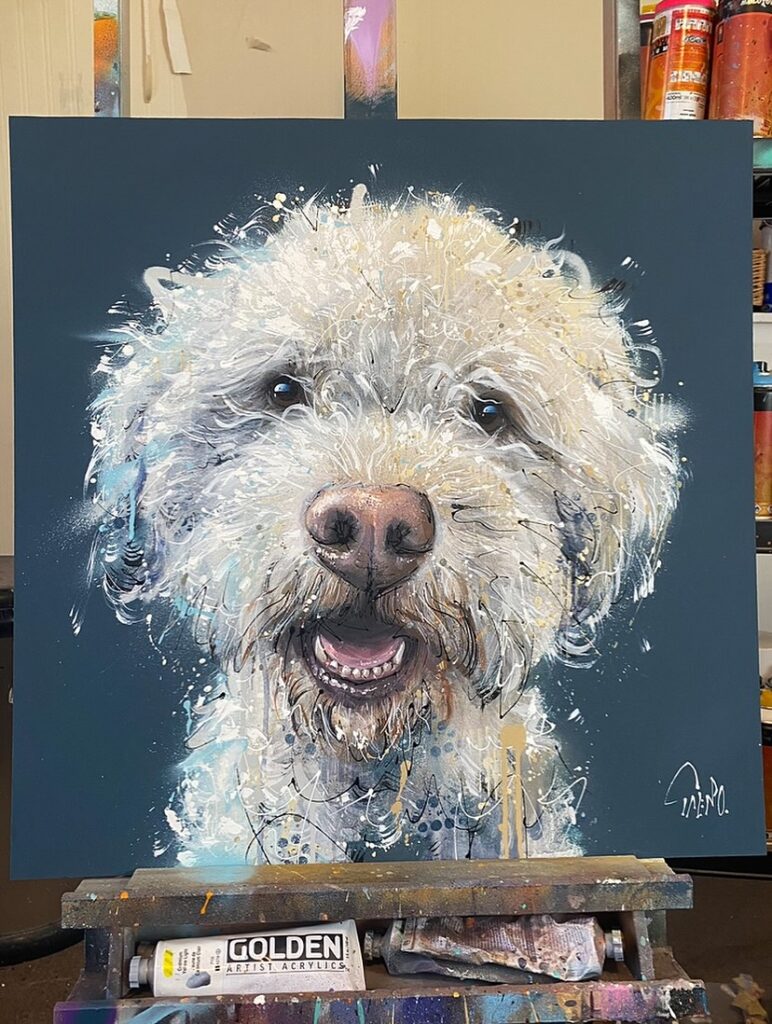
You know that moment when your golden retriever trots in from the backyard, totally soaked, shaking water everywhere, and you’re just standing there thinking — this chaotic, ridiculous face is the best thing in my life? That’s exactly the energy this painting captures. It’s bold, expressive, and somehow makes a fluffy white dog look like a literal work of fine art.
This piece features a cream and white Goldendoodle painted on a deep teal/dark blue canvas, with loose, gestural brushstrokes and gold paint splatter details layered throughout the fur. The background color is what makes it. That moody blue-gray pulls every warm white tone forward, and your eye goes straight to that goofy, open-mouthed smile.
To recreate this style, you’ll want a pre-gessoed canvas (24×24 inches works great), Golden Artist Acrylics in titanium white, raw umber, and paynes gray, plus a can of white spray paint for those wispy fur edges. The gold detail work? That’s metallic acrylic in antique gold, flicked with a stiff brush.
Start your background first — flat, matte, dark. Then build the face in loose layers, lightest colors last. The fur strokes go outward from the face, not inward.
Here’s a tip most people skip: paint the eyes before the surrounding fur. Nailing the expression early keeps the whole portrait feeling alive as you build around it.
📸 Photo credit: Instagram @galindo_artist
#2: Black Lab Portrait Painting in a Bold Pop-Art Style
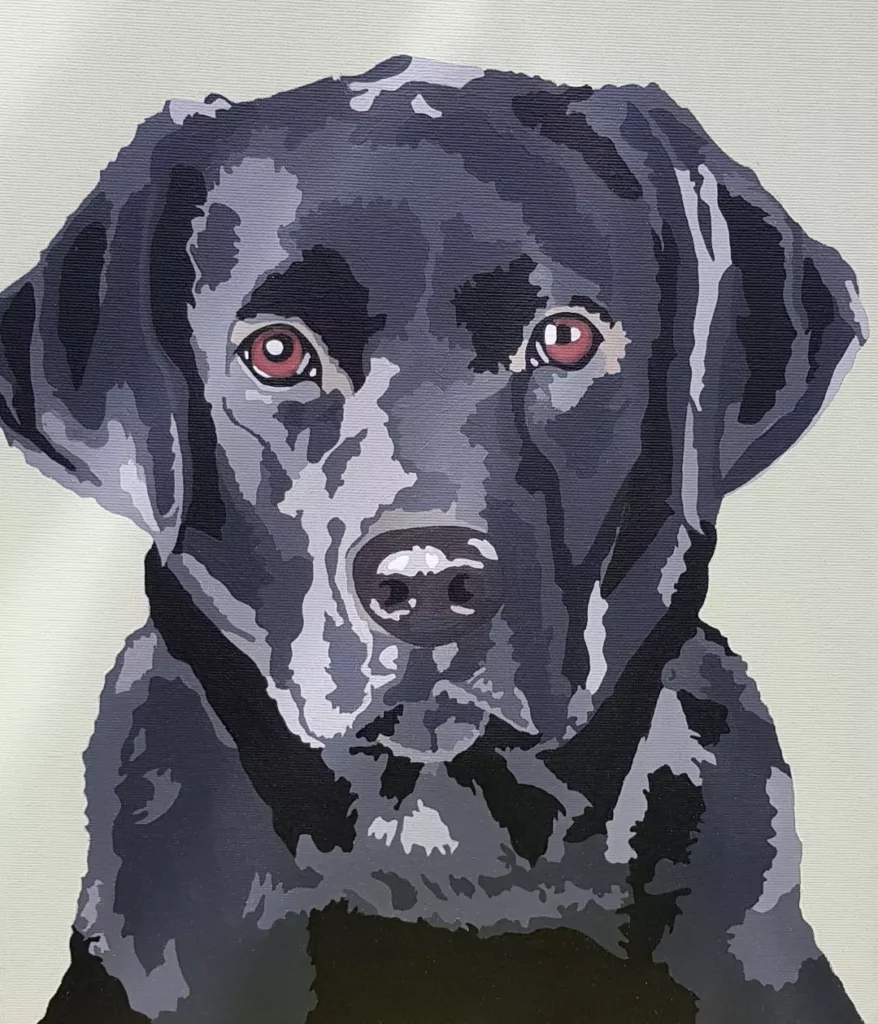
You know that moment when your golden gives you that look — soft eyes, head tilted, just begging you to put down your phone and pay attention? That’s exactly the energy this painting captures, and honestly, it stopped me mid-scroll.
This is a pop-art style portrait of a black Labrador, painted in a limited palette of black, charcoal, slate gray, and soft white, with those iconic deep red-tinted eyes that make the whole piece feel alive. The artist used a color-blocking technique — flat, defined shapes instead of blended strokes — which gives it that bold, graphic quality you see in high-end gallery prints.
To recreate this style yourself, you’ll want acrylic paint on a stretched canvas (a 16×20 inch size works great for a portrait like this). Start with a light gray background, then layer your darkest blacks first, building up to the lighter grays last. The best part: acrylics dry fast, so you can add those sharp contrast edges without muddy color mixing.
Pull your reference photo into a free app like Adobe Fresco or Procreate and run a posterize filter — it breaks your dog’s face into exactly those flat color zones before you ever touch a brush.
Use flat-head brushes in sizes 4, 8, and 12 for clean edges. And work section by section, not all at once.
Your golden’s warm coat would look stunning in this same style — think amber, honey, and cream blocking instead of gray.
📸 Photo credit: Instagram @les_tableaux_de_mimi
#3: Watercolor Eye Portrait – Painting Your Dog’s Soul One Gaze at a Time
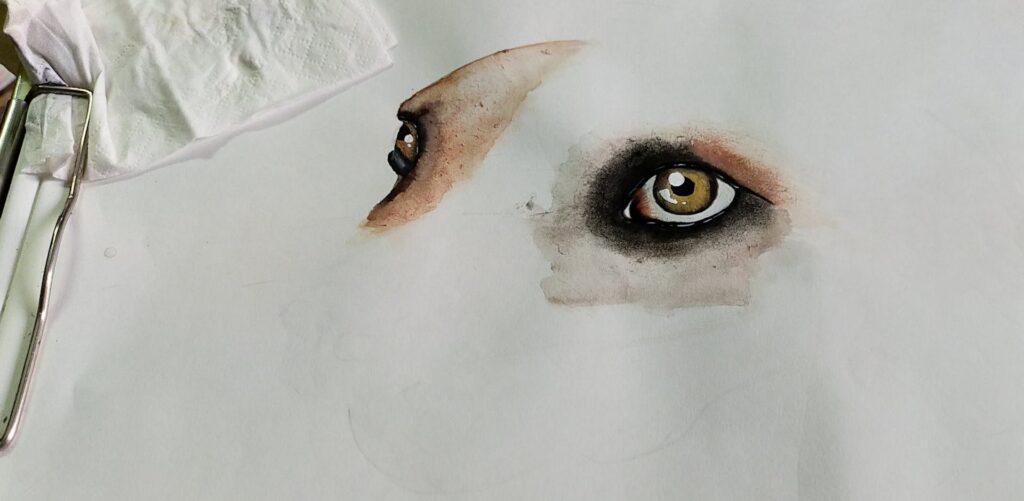
Your golden’s eyes do that thing. You know the one — that soft, golden-amber stare she gives you right before she drops her head in your lap. That look. The one that makes you want to cry a little.
This painting captures exactly that energy. Two eyes, half-finished on white watercolor paper, and somehow they already feel alive. The right eye has this deep, smoky shadow built up around it — almost like charcoal smudged into wet paint — with a warm yellow ochre iris that just glows. The left eye is still in its early wash stage, which honestly makes this even more useful to study.
Start with cold-pressed 140lb watercolor paper — it holds wet layers without warping. For the iris, mix yellow ochre + burnt sienna for that signature golden retriever amber. The dark surround uses ivory black + Payne’s grey, layered wet-on-wet so the edges stay soft and moody, not harsh.
For the highlight — that tiny white dot that makes the eye breathe — preserve it with white gouache applied at the very end with a size 0 round brush. Gouache over dried watercolor gives you that opaque pop without lifting the layers underneath.
Build the shadow around the eye socket in at least 3 separate washes, letting each dry fully. Rushing this flattens the depth. And depth is everything in an eye portrait — it’s what makes people stop and say “wait, is this real?”
Keep a piece of crumpled tissue paper nearby (just like in the photo) to blot excess water fast. Wet blooms can ruin a dark wash in seconds.
📸 Photo credit: pexels
#4: Beagle Portrait in Acrylic — The Tongue-Out, Looking-Up Pose That Melts Everyone
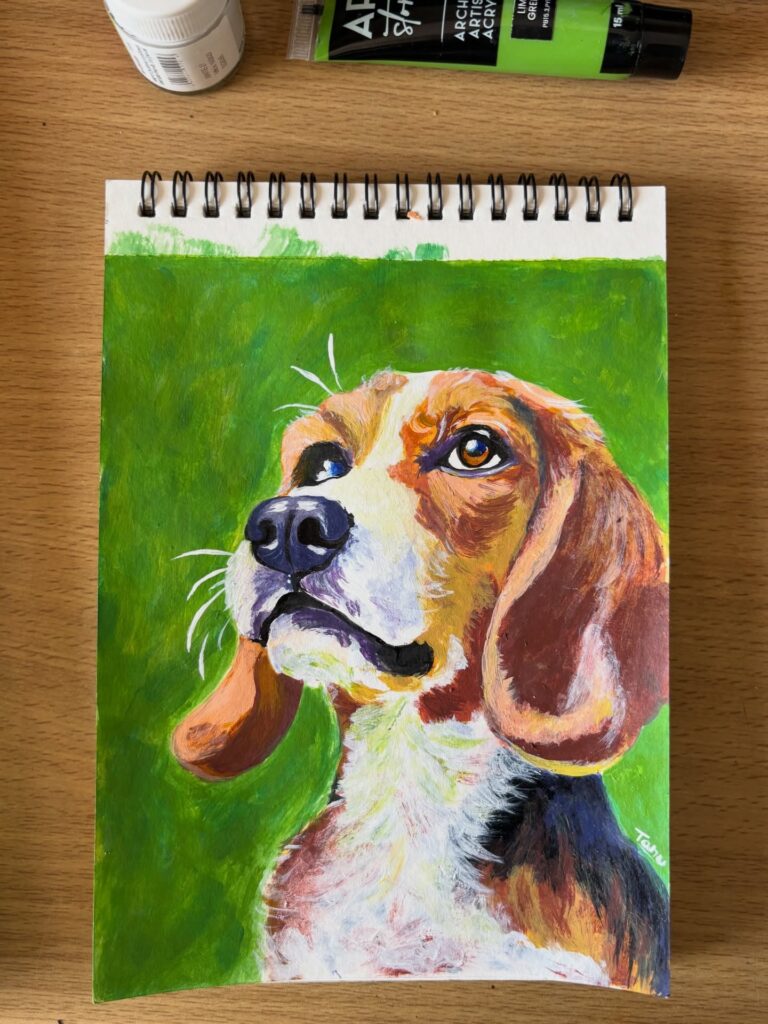
Your golden’s got that one look. You know the one — head tilted back, eyes locked on you, tongue halfway out like she’s mid-sentence. That face deserves paint and a canvas.
This acrylic painting captures a beagle gazing upward against a bold lime green background, and the energy is so alive it almost feels like the dog is about to bark at you. The loose, expressive brushwork in the fur — warm burnt sienna, raw umber, and flashes of titanium white — gives it that painterly feel without being stiff or overly realistic. It’s the kind of portrait that stops people in their tracks.
To recreate this style, grab a spiral-bound mixed media sketchpad (at least 140 lb weight so the acrylic doesn’t warp it), a tube of Archival Artist Lime Green acrylic (you can literally see it in the photo), plus your standard portrait palette: burnt sienna, raw umber, ivory black, titanium white, and a touch of ultramarine blue for shadow depth around the muzzle.
Start with a flat lime green background — two coats minimum. Then sketch your dog’s upward gaze lightly in pencil before blocking in the base fur tones. The whiskers? Save those for last, using a liner brush loaded with pure titanium white.
Painting the nose is where most people freeze up. Block it in with ivory black, then add a streak of ultramarine blue along the top edge — that blue highlight is what makes it look wet and real instead of flat.
And if you love the idea of personalizing art around your dog, Dog Custom Ideas: Unique and Personalized Items for Your Pup has some genuinely sweet directions to take this.
📸 Photo credit: Instagram @artzz_by_tanu19
#5: Watercolor Golden Retriever Portrait with a Floral Crown
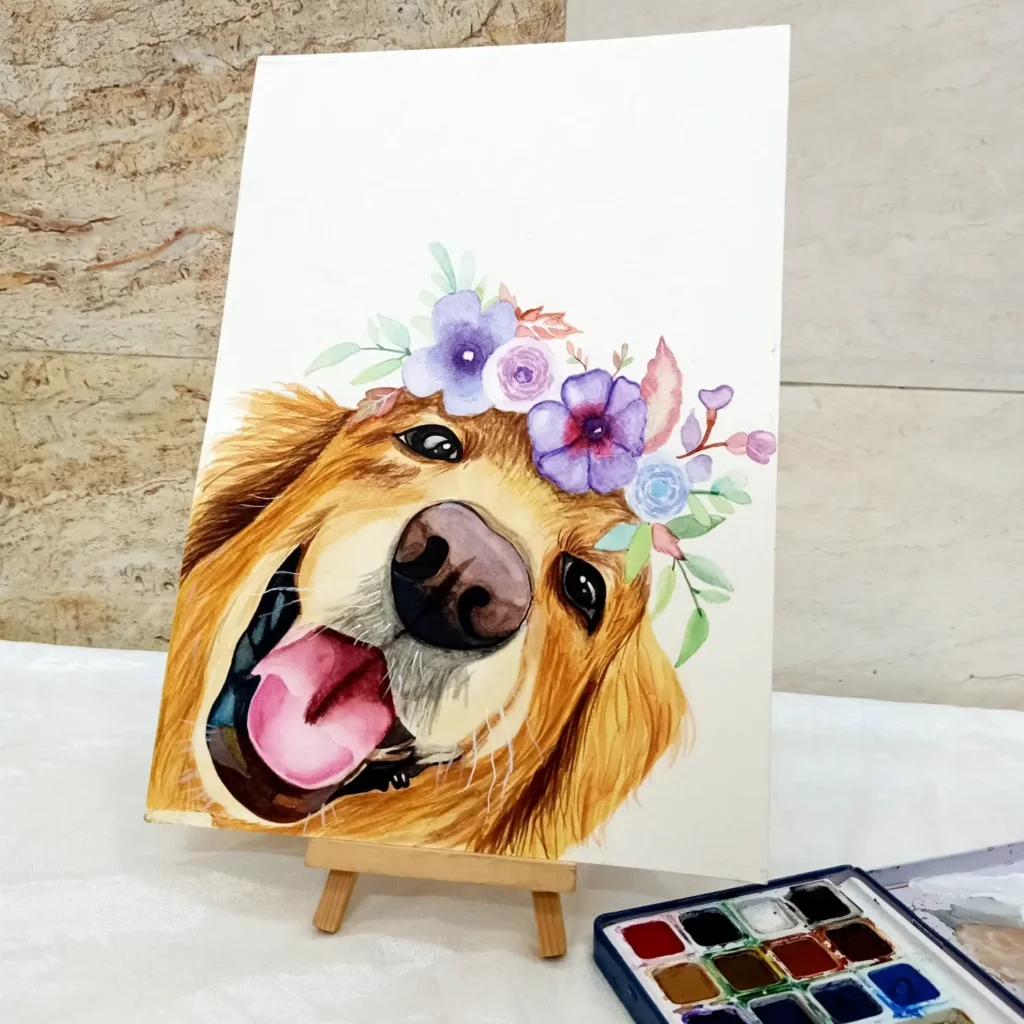
Your golden is sprawled across the couch, tongue out, looking absolutely ridiculous and perfect at the same time — and you’re thinking, someone needs to capture this energy forever. That’s exactly what this watercolor portrait does. It’s loose, warm, and full of personality, with a flower crown that somehow makes your dog look both goofy and regal.
The painting centers on a close-up golden retriever face rendered in warm amber and golden ochre watercolor washes, layered to mimic real fur texture. The flower crown sits on top — purple anemones, soft lavender roses, and a pale blue ranunculus, all painted with diluted violet and periwinkle pigments against the white paper background. The whole piece sits on a small wooden tabletop easel, which means zero wall commitment and total flexibility.
To recreate this, you’ll want cold-press watercolor paper (at least 140 lb) so the wet layers don’t buckle. Use a round brush size 6 for the fur details and a size 2 for the flower edges. The background stays completely unpainted — that negative white space is what makes the portrait feel airy and modern rather than heavy.
For the flower crown, paint each bloom separately before connecting them with thin green stem strokes. And honestly, working from a close-up photo of your dog’s face (tongue out, obviously) gives you the best reference for those expressive eyes.
📸 Photo credit: Instagram @poojas_art_classes
#6: Black Lab Portrait Painting With Bold Brushwork on a Warm Sienna Background
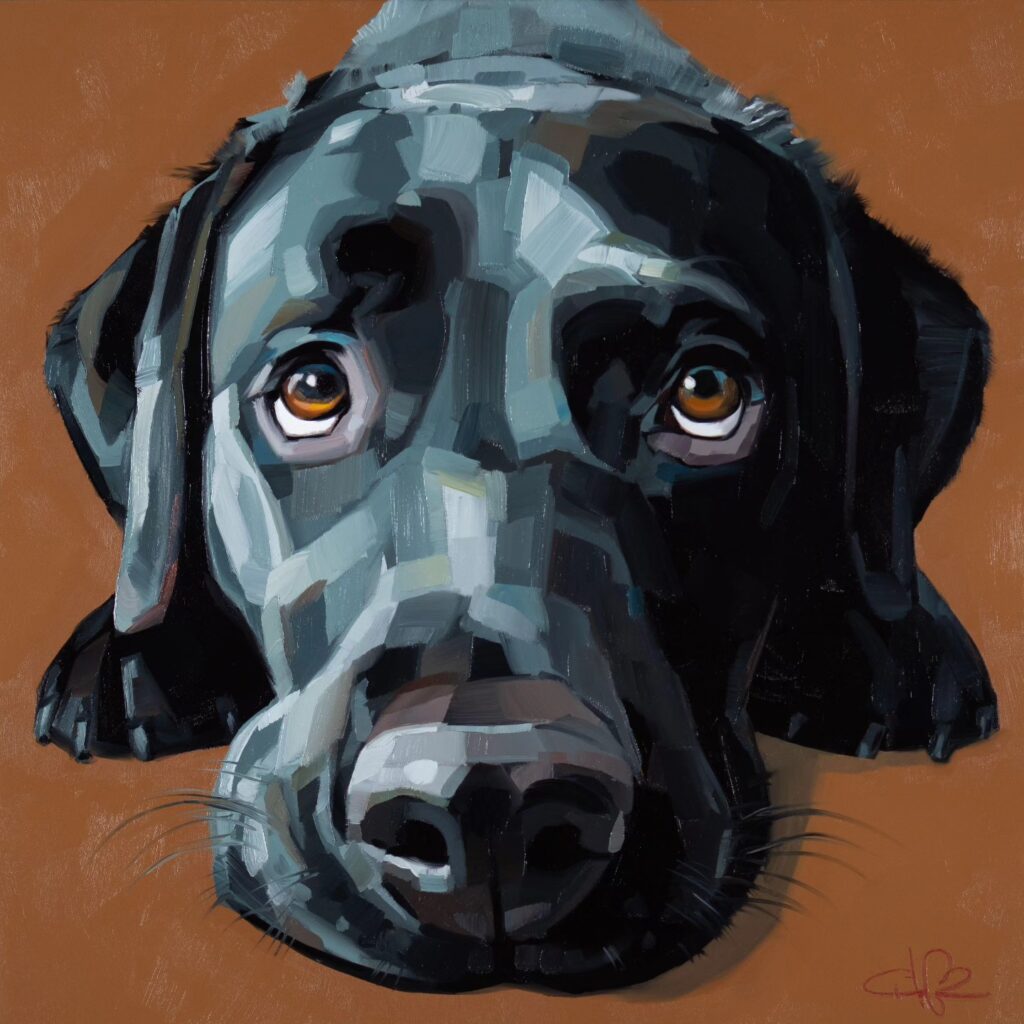
You know that moment when your dog just stares at you — chin resting on the floor, those big brown eyes locked onto yours like you’re the only person in the universe? That’s exactly the energy this painting captures.
This is a close-up oil portrait of a black Labrador, painted in a loose, painterly style using chunky, mosaic-like brushstrokes in cool blue-gray and slate tones against a warm burnt sienna background. The contrast is everything — that rich terracotta orange makes the dark fur practically glow.
The magic here is in the eyes. The artist uses bright amber-brown irises with a sharp white highlight dot — that one tiny detail makes the whole painting feel alive. And the brushwork doesn’t try to be photorealistic. Instead, it lays down bold, confident strokes of titanium white, Payne’s gray, and raw umber to build up the muzzle and forehead, letting the dark base coat show through the gaps like shadow.
To recreate this style, grab a 12×12 inch canvas board, prime it with burnt sienna acrylic as your base color, and let it dry completely before you start. Work from dark to light — block in the black fur zones first, then layer your cool highlights on top.
Real talk: the secret to those glassy eyes is a size 0 round brush with undiluted white. One dot. Don’t overwork it.
📸 Photo credit: Instagram @cristallharper
#7: Watercolor Dog Portrait — The Soft, Moody Style That Makes People Stop and Stare
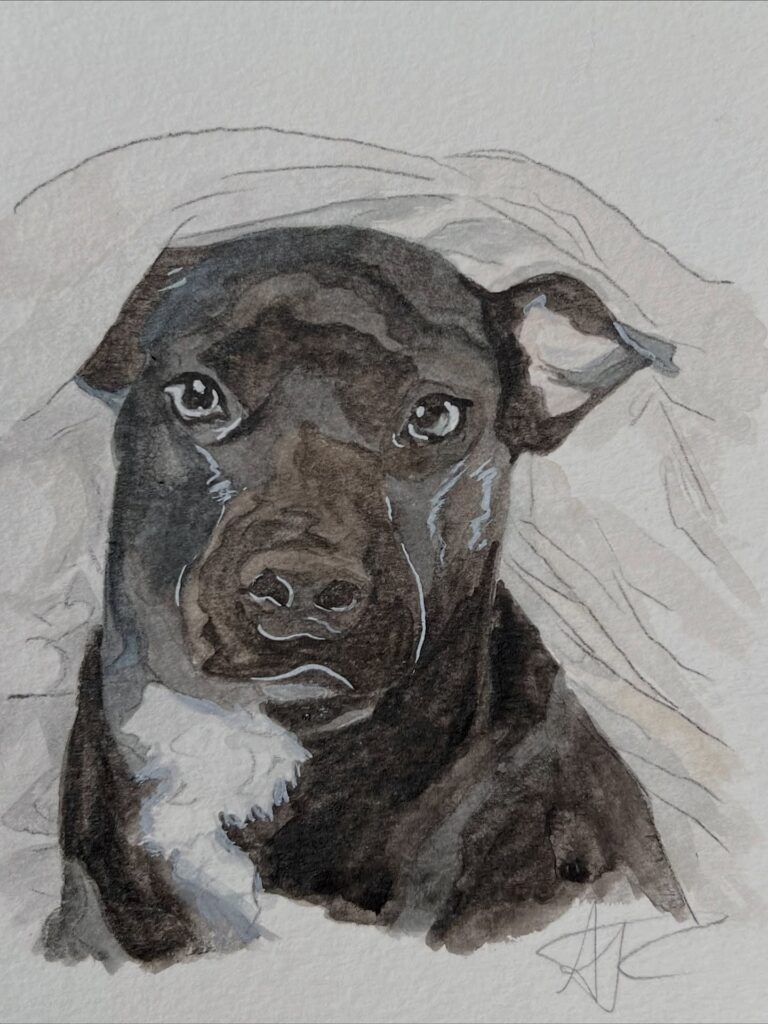
You know that moment when you look at your golden and just feel something? Like, your chest gets all tight and you want to freeze that exact face forever. That’s exactly what this painting does — and honestly, it hit me so hard the first time I saw a piece like this.
This is a watercolor portrait done in a limited grayscale palette — think cool grays, warm browns, and deep charcoal blacks, with almost zero color saturation. The background stays loose and sketchy, with pencil lines left showing on purpose. It gives the whole thing this raw, unfinished beauty that somehow feels more emotional than a photo.
To get this look, you need cold-press watercolor paper (at least 140 lb / 300 gsm) — that texture is what creates those gorgeous pooling effects in the fur. Your paint colors should stay tight: Payne’s gray, burnt umber, raw sienna, and lamp black. The artist used a fine liner or white gel pen to pull out whisker highlights and nose details after the paint dried.
The sketch underneath isn’t hidden — it’s part of the piece. Lightly draw your dog’s portrait in HB pencil, then layer transparent watercolor washes, letting earlier layers dry completely between applications.
What this means for you: the loose pencil lines stay visible because they add depth, which means you don’t need to be a perfectionist to make this work.
Work wet-on-wet for the fur background, then switch to dry brush for crisp facial details like the eyes and nose. Those bright white highlights in the eyes? Leave the paper bare or lift wet paint with a dry brush — don’t paint white over dark.
📸 Photo credit: Instagram @pawportraiture
#8: Mini Canvas Pet Portrait Painting (The Cutest Personalized Dog Art Idea)
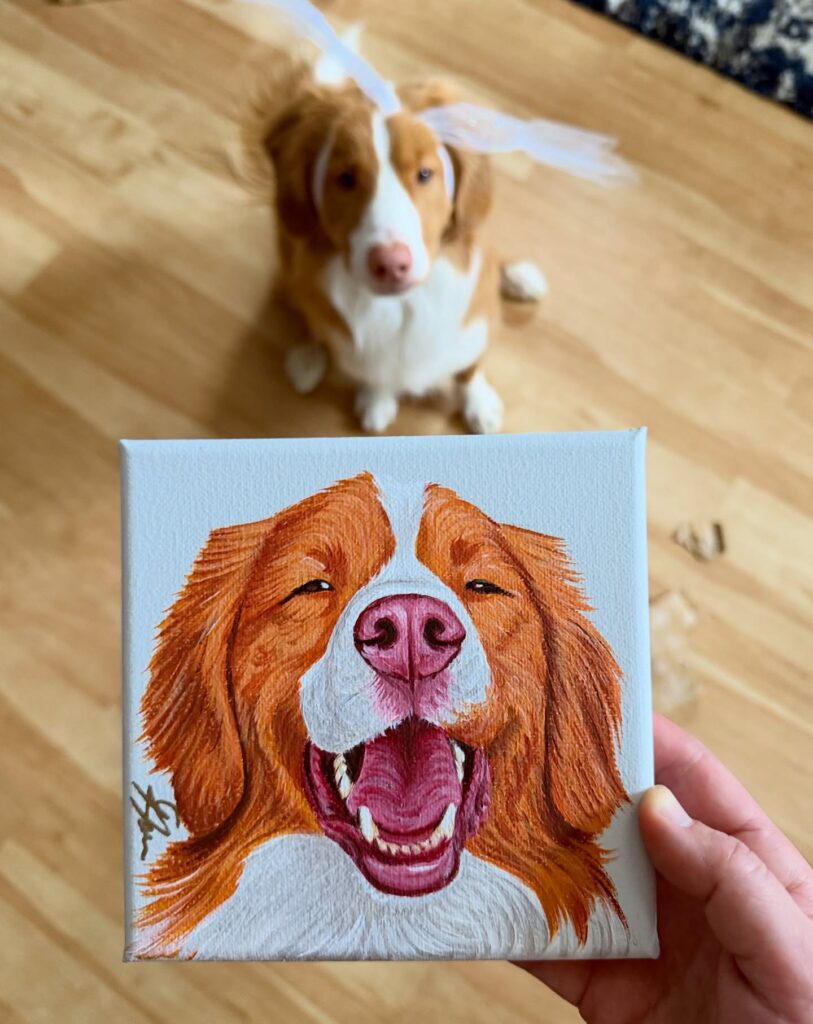
Your golden is flopped on the couch, drool on the cushion, paw prints on the floor — and somehow still the most beautiful thing in the room. What if you had a tiny painting of that exact face staring back at you from your shelf?
This is a mini canvas pet portrait — painted in acrylic on a 4×4 inch or 5×5 inch stretched canvas — and it’s honestly one of the most personal dog painting ideas out there. The painting in this photo captures a Nova Scotia Duck Tolling Retriever with burnt sienna, raw umber, and titanium white acrylics, with incredible fur texture built up using a fine detail brush (size 0 or 1) and a fan brush for the fluffy outer coat.
To recreate this, you’ll need a mini stretched canvas (grab a pack of 10 from Arteza or Blick), a set of heavy body acrylic paints, and reference photos taken in natural light — that’s what makes the colors pop.
Start with the nose and eyes first. Those anchor the whole likeness. Work outward using short flicking strokes for fur, layering lighter tones over darker ones once dry.
The small size means less intimidation, faster finish, and a result you’ll actually frame — that payoff hits different when it’s your dog’s goofy smile on the canvas.
📸 Photo credit: Instagram @two.mountain.tollers
#9: Siberian Husky Portrait Painting on a Light Blue Background
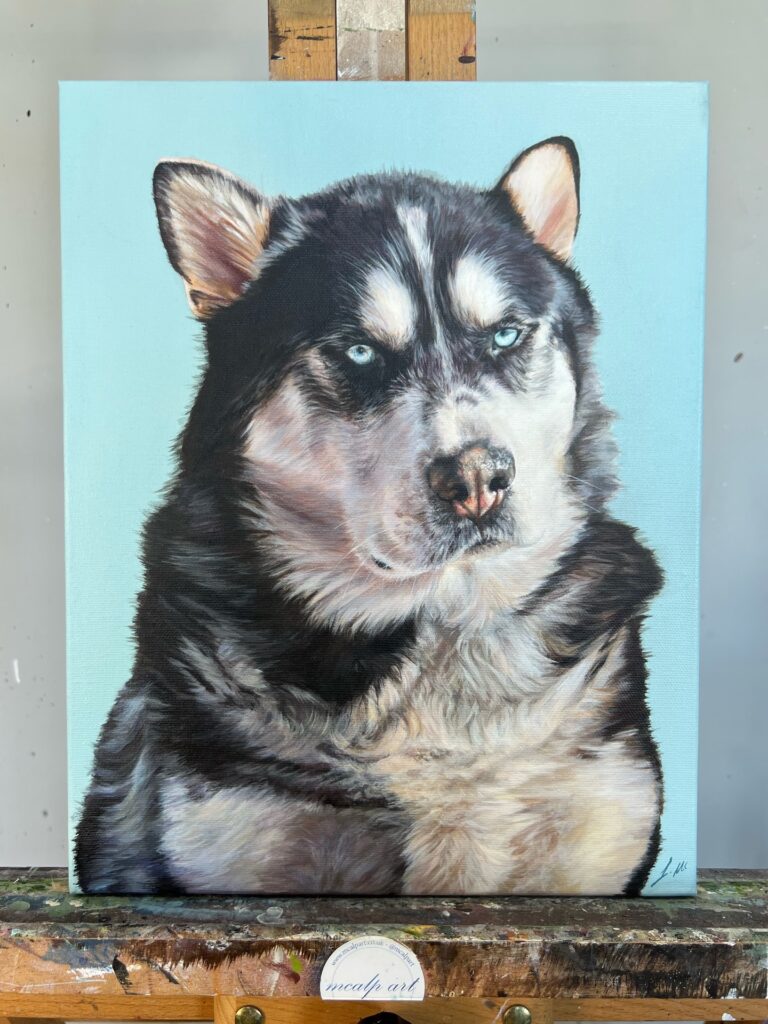
You know that moment when your golden is just lounging there, paws crossed, looking at you like she owns the place? That energy — that regal, unbothered vibe — is exactly what this painting captures. This is a hyper-realistic oil portrait of a Siberian Husky, painted on a light blue canvas background, and honestly it stopped me mid-scroll.
The artist used oil on canvas to build up those layers of black, grey, and warm tan fur — you can almost feel the thickness of the coat. Those icy blue eyes pop against the pale background in a way that’s impossible to ignore. The composition is a classic bust-style portrait, cropped just below the chest, which gives it that old-school formal painting energy but for your dog. I love that.
To recreate this style, you’d want a 12×16 inch stretched canvas, titanium white, ivory black, burnt sienna, and ultramarine blue oil paints, and fan brushes in sizes 2 and 4 for fur texture. The background color here is close to Benjamin Moore “Azure Wish” — soft enough to let the subject breathe.
Here’s the trick: paint the background before the subject, let it cure for 48 hours, then build the fur in directional strokes from base coat to highlight. Painting fur dark-to-light gives it that realistic depth without overworking the surface.
Commission this from a pet portrait artist or try it yourself — capturing your golden in this style means the fur detail will literally glow with those warm honey tones against a pale background.
📸 Photo credit: Instagram @mcalpart
#10: Bold & Colorful Pop Art Dog Portrait Painting
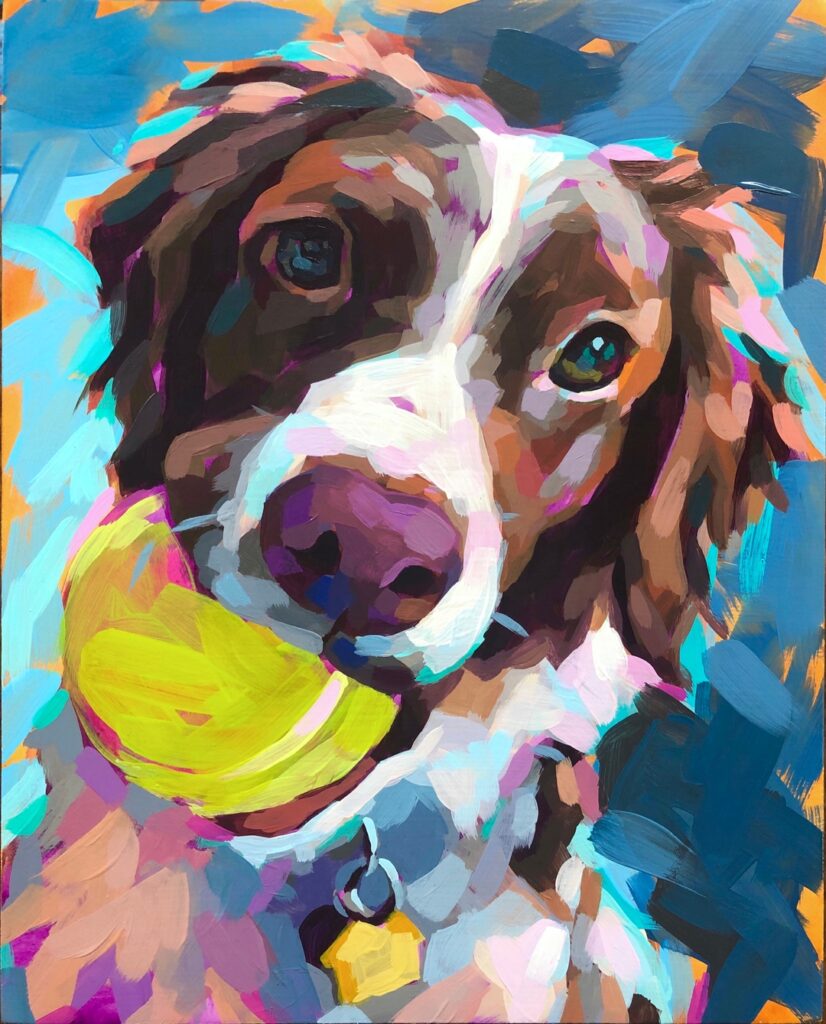
Your golden retriever gives you that look — tennis ball in mouth, eyes locked on yours, like she’s saying “paint me already.” And honestly? She deserves it.
This painting is an explosion of color done right. Think electric turquoise brushstrokes, warm orange backgrounds, and bold magenta shadow tones layered over a realistic dog portrait. The style is loose, expressive pop art — the kind that stops people mid-conversation when they walk into your living room.
To recreate this, you’ll need heavy-body acrylic paint in a palette that includes cadmium yellow, phthalo turquoise, dioxazine purple, burnt sienna, and titanium white. The canvas size here reads around 16×20 inches, which gives you enough room to capture those close-up facial details without losing the loose, gestural brushwork that makes the whole thing sing.
The background uses a wet-on-wet technique — load your brush with turquoise and drag it across a still-wet orange base. That’s what creates those gorgeous blended streaks. Don’t smooth it out. The messiness is the magic.
For the dog’s face, work in flat color shapes first — no blending, just bold blocks. The purple nose, the brown patches, the white blaze. Then layer in your highlight colors (pink, teal, peach) on top to add dimension. Think Fauvism meets your best friend.
Worth it because: commissioning or painting this yourself — acrylic on canvas costs under $40 in supplies — means you get one-of-a-kind wall art that makes your home feel like a gallery and celebrates your girl.
📸 Photo credit: Instagram @ali_kay_studio
The One Thing Most People Get Wrong When Painting Their Dog
Okay, so here’s the pro secret nobody tells you — the reference photo is everything, and most people pick the wrong one.
I learned this the hard way after commissioning a portrait of my cousin’s husky. She sent a cute selfie with him, but half his face was in shadow. The finished painting? One eye looked smaller than the other and his fur coloring was totally off. Heartbreaking.
For golden retrievers specifically, you want a photo taken in natural outdoor light — not flash, not shade. That warm amber fur needs true light to capture every tonal shift. Indoor photos flatten all that gorgeous color into one muddy blob.
The second mistake? Choosing a pose over a personality. Your girl probably does this thing — a head tilt, a specific goofy grin. That’s the reference you want. An artist can recreate a pose anywhere, but they can’t recreate a moment they never saw.
And honestly, if you’re already obsessing over capturing her personality on canvas, you might also love how 13 adorable dog birthday photoshoot ideas can get you that perfect reference shot too.
Your Dog’s Comfort Starts With One Good Decision
Pick one idea from this post and just start. You don’t need to redo your whole house or spend a fortune. Even swapping out a scratchy old bed for something cozy makes a real difference — your golden will feel it, and honestly, so will you.
If you want to take it further, these stylish DIY dog crate furniture ideas are so good for keeping things Pinterest-worthy without sacrificing your dog’s space.
Small change, big win: one weekend project can turn a chaotic corner into something you’re proud to show off.
So — which idea are you trying first? 🐾