
You grab your sketchbook, sit down with a cup of tea, and just… freeze. Your golden retriever is sprawled across your feet looking absolutely paintable, and you’ve got zero clue where to even start.
That blank page hits different when you want to make something beautiful.
I’ve been there so many times. Last winter I spent like 20 minutes just staring at my cousin’s dog, pencil in hand, completely lost. No reference, no direction — just vibes and frustration.
Here’s the thing about dog drawing ideas: most lists online are either way too technical or so basic they feel insulting. You want something that actually matches your aesthetic — the kind of art that looks stunning framed above your entryway or tucked into a Pinterest board you’re proud of.
These 7 ideas? They’re exactly that. Doable, gorgeous, and made for someone who actually loves their dog.
#1: Charcoal Golden Retriever Portrait — The Close-Up That Captures That Look
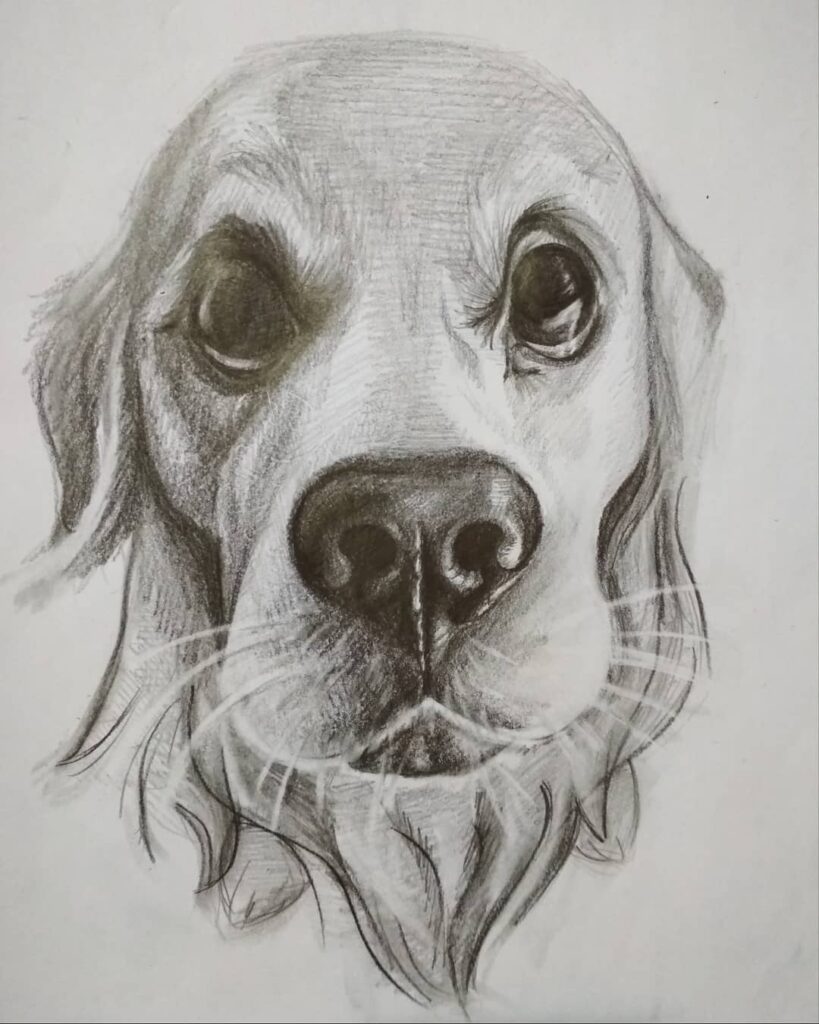
You know that face your golden gives you right before dinner? Those big, melty eyes half-drooping, nose practically pressed against your leg? That’s the face this drawing nails — and honestly, the first time I saw it, I got a little emotional.
This is a charcoal pencil portrait on white drawing paper, done in a close-up composition that fills the entire page with just the dog’s face. The artist leaned hard into contrast — the nose is nearly jet black, the muzzle is left almost white, and the fur around the ears fades into soft shadow. It feels less like a drawing and more like a memory.
Start with vine charcoal for your base sketch — it’s forgiving and easy to erase. Then build up depth using compressed charcoal sticks for the darkest areas (nose, pupils, ear shadows). The whiskers? Those aren’t drawn in — they’re scratched out using a sharp eraser pen or the edge of a kneaded eraser. That trick alone changes everything.
Pull highlights back out of the fur using a blending stump plus your kneaded eraser. Light, lifting strokes. The muzzle blaze — that bright white strip running down the center of a golden’s face — is your anchor point. Build everything else around it.
Work the eyes last. Dark irises with a single sharp white chalk highlight — that’s the feature that adds depth, creates emotion, and makes the portrait feel alive rather than flat.
📸 Photo credit: Instagram @mell.art
#2: Colored Pencil Dog Portrait (Hyper-Realistic Style)
You know that photo you have of your golden where the light hits her eyes just right and you think — someone needs to turn this into real art? This is exactly that.
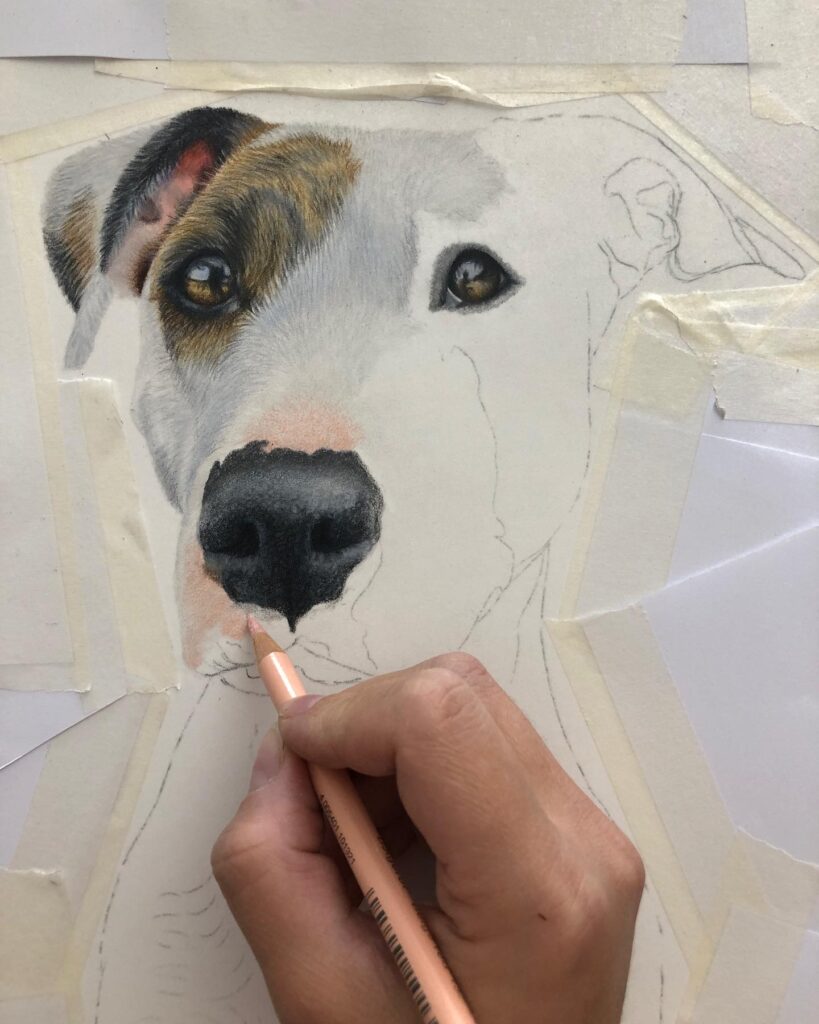
This work-in-progress portrait uses colored pencils on smooth white drawing paper, taped down with painter’s masking tape to keep the edges clean while different sections get completed. The left side is already bursting with life — warm brown, olive green, and deep black layered over the fur — while the right side is still in pencil sketch form. And that contrast? It’s genuinely stunning to see.
The artist is working with what looks like a light peach/skin-tone Polychromos or Prismacolor Premier pencil to build up the muzzle area. The nose uses heavy cool black layered in circular strokes to mimic the bumpy texture of a real dog nose. The eyes are done with golden amber at the center and dark brown ringing the iris — that’s what gives them that soulful, alive quality.
Start with the eyes first. Getting the eye color right early gives you a reference point for every other value in the portrait — it sets the whole emotional tone of the piece.
Work one section at a time instead of the whole face at once. Tape off finished areas with low-tack tape so your hand doesn’t smudge the layers you’ve already built.
Layer colors in the direction the fur actually grows. This feature — directional strokes — creates depth that flat shading never could, and the payoff is a portrait that looks like a photograph.
📸 Photo credit: Instagram @georgieturnerartist
#3: Paint a German Shepherd Portrait Using Reference Photos (Oil on Canvas)
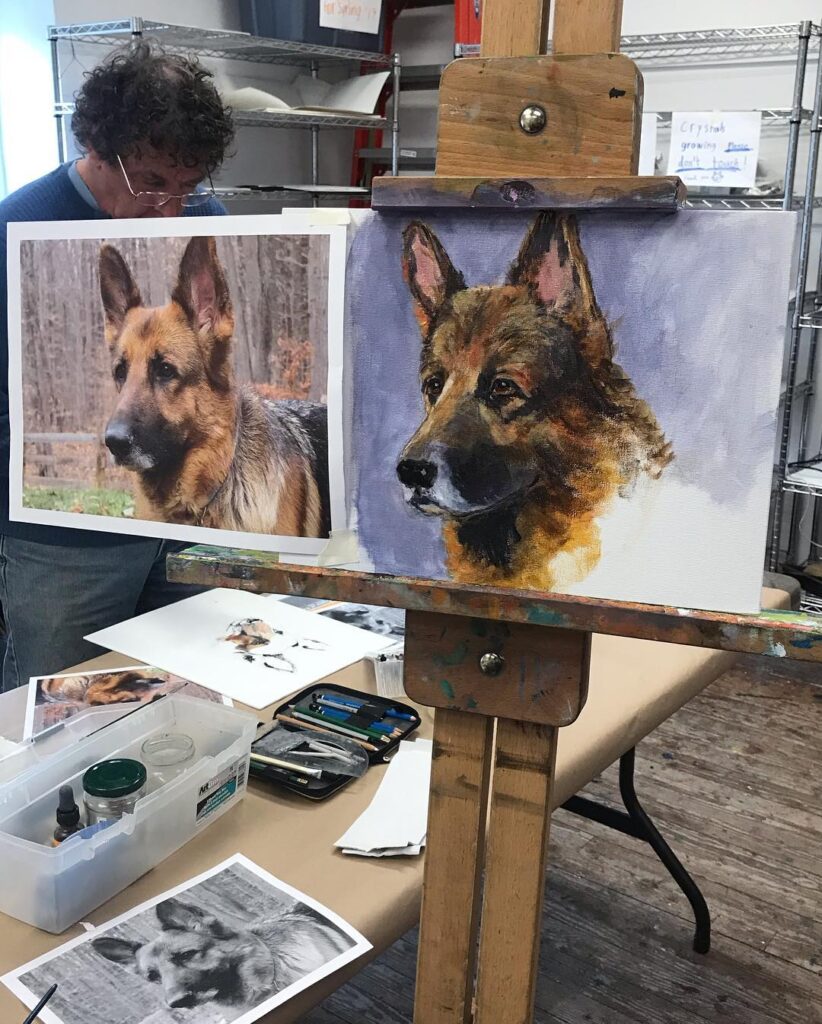
Okay so this one completely stopped me in my tracks. An artist set up a wooden easel with a photo of a German Shepherd pinned right next to a canvas in progress — and the painting already looks stunning halfway through. The warm browns and blacks against that soft lavender-grey background? Chef’s kiss.
The setup uses a wood easel with a built-in clamp to hold both the reference photo and the canvas board side by side. That’s the move right there — keeping your reference at eye level so you’re not constantly looking down. The artist works with a pencil sketch underlayer, then builds up with oil or acrylic paint in burnt sienna, raw umber, and ivory black. You can see the paint palette tray loaded with brushes nearby, plus small glass jars for medium or water rinse.
The lavender-grey background isn’t random. Painting a neutral-cool tone first makes the warm dog fur colors pop without extra effort — that’s the feature-benefit-payoff right there: one background color, zero muddiness, maximum contrast.
Print your reference photo at 8×10 inches minimum. Anything smaller and you’ll lose the fur detail around the ears and muzzle — which, if you have a golden retriever, you know that face deserves every strand.
Sketch the head shape in 3 basic geometric forms first: circle for the skull, triangle for the snout, two triangles for the ears. Block in your darkest shadows before adding mid-tones.
📸 Photo credit: Instagram @andrea.gianchiglia.art
#4: Colored Pencil Dog Portraits With Expressive Tongue-Out Poses
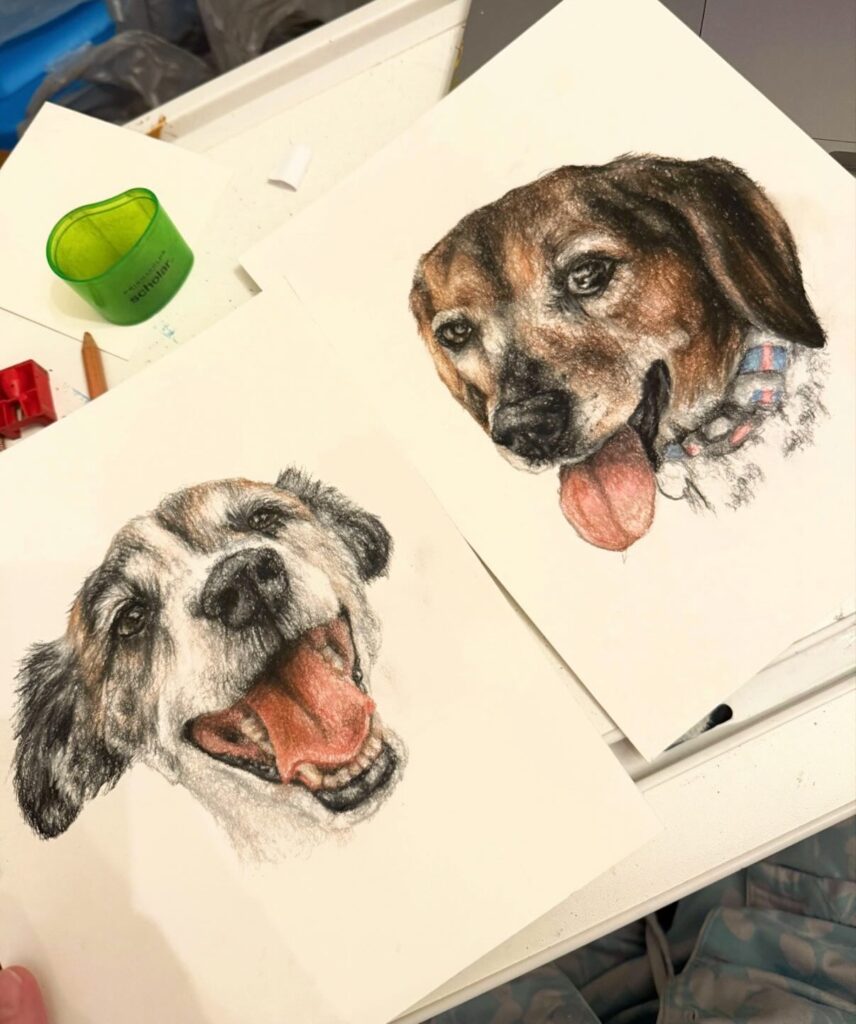
You know that moment when your golden is mid-zoomie, tongue flapping sideways, and you think — somebody needs to draw this exact face?
That’s the whole energy of this drawing idea, and honestly it’s one of my favorites to talk about.
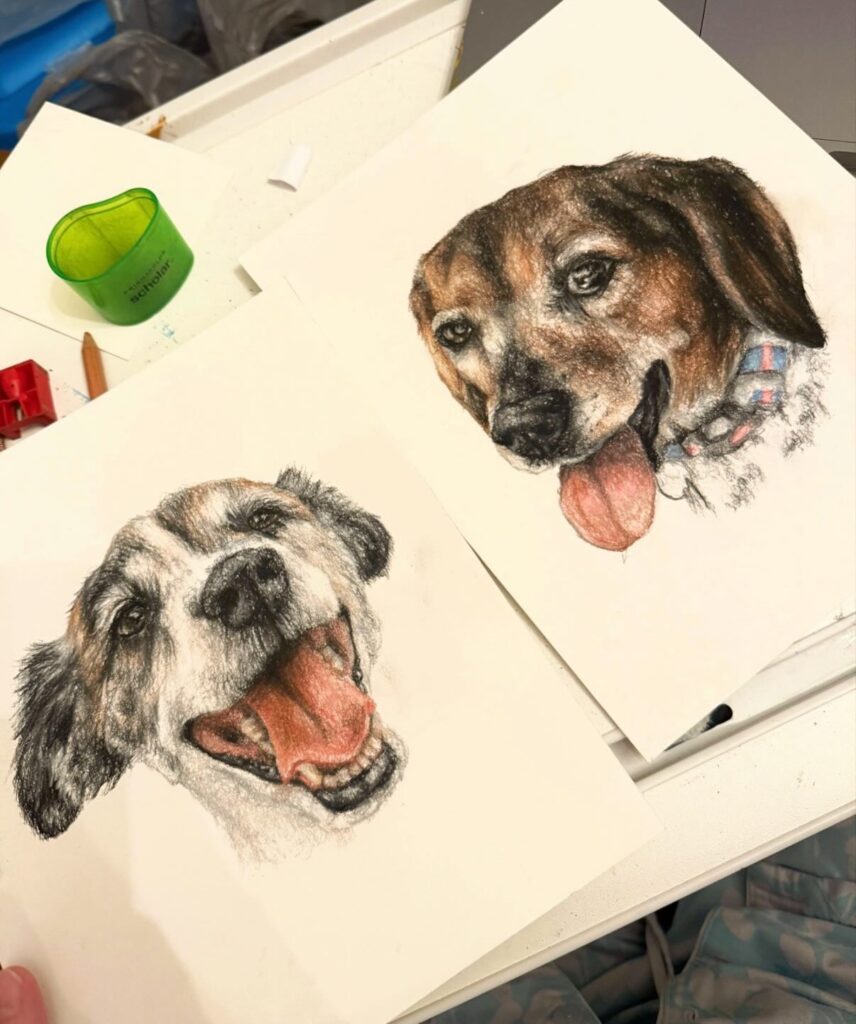
These two portraits are done in colored pencil and charcoal on smooth white cardstock, and the combo is doing so much heavy lifting here. The bottom portrait leans almost fully into graphite and charcoal with just a blush of terracotta-toned pencil on the tongue and inner mouth — giving it this raw, sketch-journal feel. The top one goes full color — burnt sienna, raw umber, black, and warm white pencil layered over each other to nail that brown-and-tan brindle coat. And that little plaid bandana detail in the top right? Chef’s kiss.
To pull this off, grab a Prismacolor Premier colored pencil set (at least 48 colors), a General’s charcoal pencil set, a Prismacolor Scholar pencil sharpener (you can literally see the green one sitting right there in the photo), and Bristol smooth paper or cardstock in 100lb weight. The smooth surface lets colored pencils blend without fighting the paper texture.
Start with your lightest fur tones first — like cream or light tan — then layer darker shades on top. Burnishing with a white pencil at the end pops the highlights and gives fur that soft, almost-fluffy look.
Quick note: photographing your dog mid-pant actually gives you the best reference shot for this style — open mouth, visible tongue, relaxed ears. Way more personality than a posed sit-stay photo.
If you love capturing your dog’s personality in art like this, Dog Custom Ideas: Unique and Personalized Items for Your Pup has some really fun directions you can take it beyond just drawings.
The tongue-out pose works so well because it catches them in a real, unguarded moment — and that’s what makes the portrait feel alive instead of stiff.
📸 Photo credit: Instagram @rightside.of.elizas.brain
#5: Black Fluffy Dog Portrait in Colored Pencil and Marker
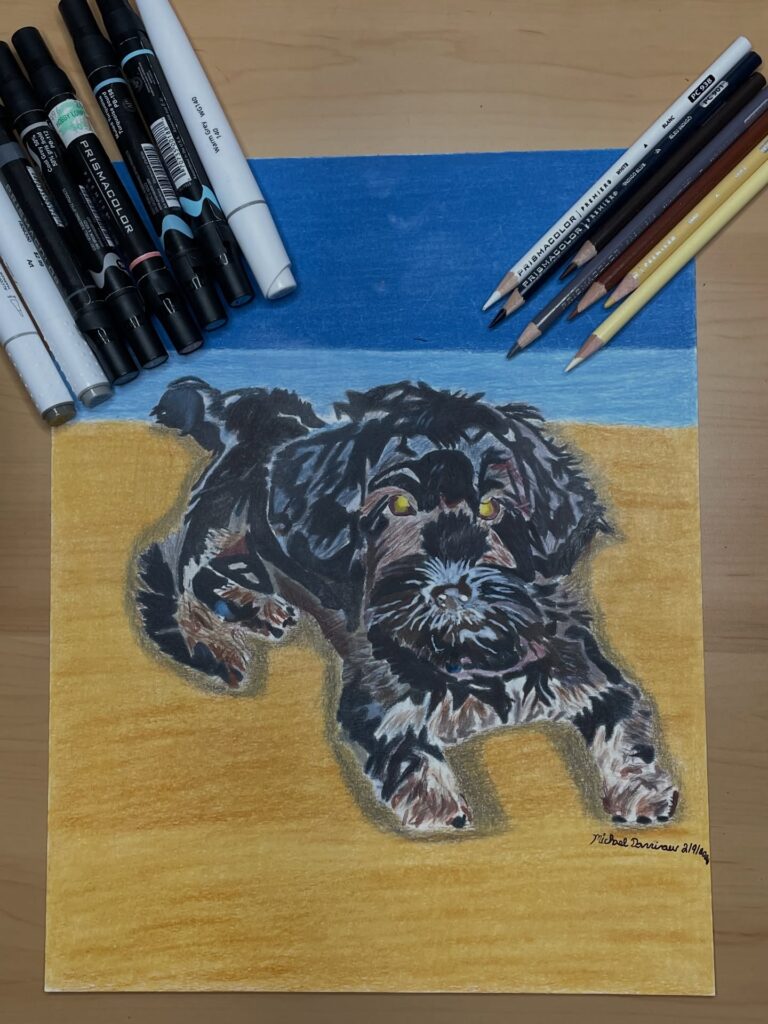
Your golden retriever is flopped across the floor, fur catching the afternoon light, and you’re thinking — someone needs to capture this exact moment forever. This drawing does that.
This piece shows a dark, fluffy puppy sprawled on a sandy surface with a soft blue horizon behind it. The artist used Prismacolor Premier colored pencils layered over alcohol-based Prismacolor markers to build that rich, dimensional fur texture. The yellow-gold eyes are what pull the whole thing together — they stop you mid-scroll.
The background stays simple on purpose. A warm ochre yellow for the ground (think PC-942 Yellow Ochre) and a two-tone blue sky using a light cerulean marker blended with a pale blue pencil on top. That contrast makes the dark fur pop without any complicated techniques.
The fur itself layers black, warm brown, and white Prismacolor pencils in short, overlapping strokes that follow the direction of the hair growth. The white highlights — especially around the muzzle and paws — are what give it that fluffy, three-dimensional feel. Skip the white until the very last layer so it sits on top and catches the eye.
Work on toned tan paper instead of white — the paper color becomes your mid-tone automatically, cutting your shading work in half.
📸 Photo credit: Instagram @mikelovesdrawing
#6: Two Dogs Playing Pencil Drawing — Capturing Movement and Personality Together
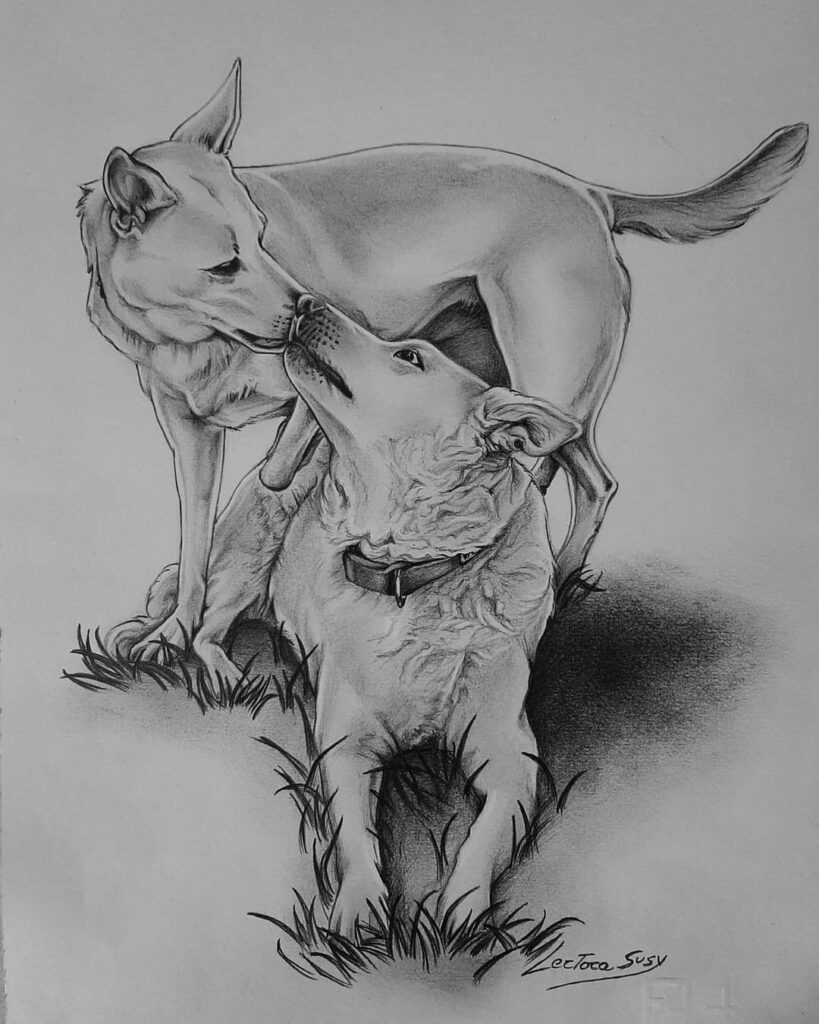
You know that chaotic, joyful moment when your golden retriever goes absolutely feral playing with another dog in the yard? Noses bumping, one dog practically climbing over the other, tails going a million miles a second? That is exactly what this pencil drawing captures — and it’s stunning.
This piece shows two dogs mid-play, one standing over the other with their noses touching. The artist used graphite pencil on white drawing paper to build up realistic fur texture through layered, directional strokes. The shadows underneath the dogs are deep and dramatic — rendered in heavy 6B or 8B graphite — which is what makes the whole composition feel grounded and alive.
To recreate this, start with smooth Bristol board or heavyweight cartridge paper (at least 180gsm). You’ll need a full pencil range — HB for initial sketching, 2B–4B for mid-tone fur, and 6B–8B for those rich, dark shadow pools beneath the dogs’ feet. A blending stump and a kneaded eraser are non-negotiable for pulling out those bright chest highlights.
The grass detail at the base is quick, loose, and gestural — just short flicked strokes with a sharp 2B pencil. That contrast between tight fur rendering and loose ground texture gives the drawing breathing room.
Capture the weight of one dog leaning over the other by darkening the contact points — where the paw presses down, where the nose meets the muzzle. Those pressure points, rendered dark, create believable physical weight that flat shading never achieves.
📸 Photo credit: Instagram @susy.lertora.art
#7: Loose Ink Sketch-Style Dog Portrait
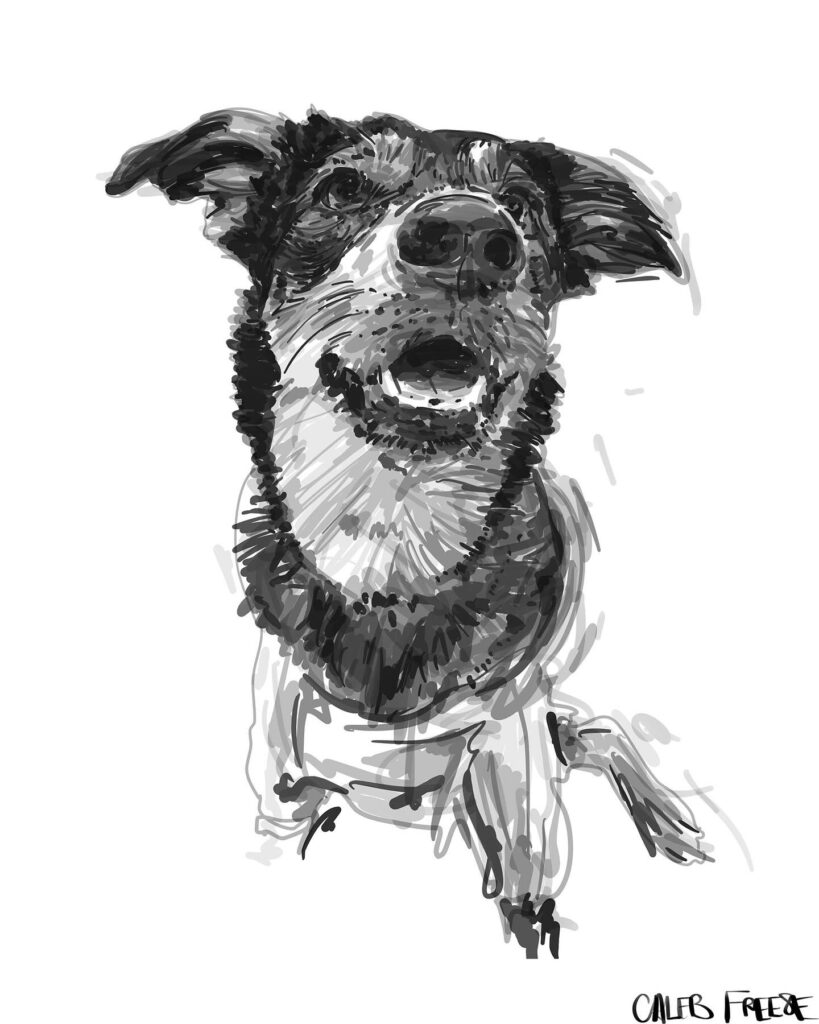
Okay so you know that moment when your golden is just staring at you with that goofy open-mouth smile and you’re like — I need to capture this forever?
This drawing is exactly that energy. It’s a loose, expressive ink sketch of a mixed-breed dog caught mid-happy — mouth open, ears flopped sideways, whole body leaning in like he’s about to knock your coffee over. The style is digital but feels hand-drawn, with quick gestural strokes layered in black, dark charcoal, and cool gray tones on a stark white background. No fancy background, no props. Just pure dog personality.
The artist, Caleb Freese, builds the portrait using rapid crosshatching and scribble-line shading — darker clusters around the ears and collar, lighter feathered strokes on the muzzle and chest. That contrast is what gives it so much depth without being overworked.
To recreate this style digitally, you’d want a pressure-sensitive stylus, a drawing app like Procreate, and a textured ink brush set. Start with your golden’s face straight-on, sketch the darkest areas first (ears, nostrils, collar shadow), then build mid-tones with loose overlapping strokes. Don’t tighten it up — the messiness is the magic.
Print it on matte fine art paper, 8×10 or 11×14, and frame it in a simple black or natural wood frame. It hits different on a gallery wall than a photo does.
Work fast and resist the urge to erase. The scribbled, unfinished edges make the dog look alive.
📸 Photo credit: Instagram @zoooooooooom
The One Dog Drawing Mistake That’s Killing Your Artwork (And How to Fix It)
Okay, real talk — most people start drawing their dog’s face from the nose up. Total trap.
The nose anchors everything. Sketch it first, then build outward. Golden retrievers especially — that soft muzzle shape determines whether your drawing looks like your actual dog or some random fluff blob.
Here’s the pro secret nobody tells you: draw the wet parts first. The nose, the eyes, the inner corners of the mouth. Those shiny, dark areas create contrast that pulls the whole portrait to life. My art teacher called them “anchor darks” and honestly, once I started doing this, my sketches went from flat to wow so fast.
One more thing — stop drawing fur as individual hairs. Golden fur moves in clumps, like thick brushstrokes. Sketch directional flow lines instead. Way faster, way more realistic.
Try this first: grab a photo of your pup in natural window light. That soft shadow on one side of their face? That’s your roadmap for every value decision in the drawing.
Your Golden Deserves a Clean Home (And So Do You)
Pick one idea from this list and just start. Seriously, even the smallest change — a washable throw, a dedicated wipe-down station by the door — makes a real difference by the end of the week.
Your home can look Pinterest-worthy and survive a muddy golden retriever. Those two things aren’t mutually exclusive, I promise.
And hey, if you’re thinking about keeping your pup out of certain rooms while you style things up, these genius dog barrier ideas every pet owner swears by are worth a look.
So tell me — which idea are you trying first?