
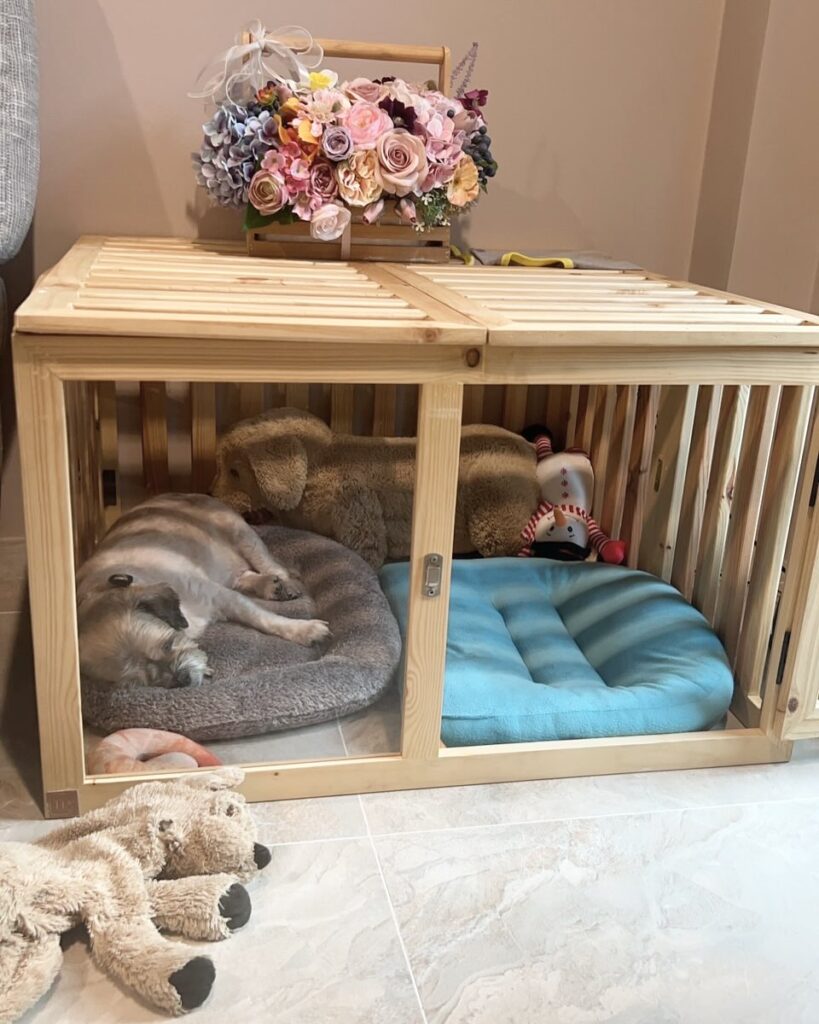
Okay, so you know that moment when your golden tracks mud across your just-cleaned rug and then has the audacity to look cute about it?
Yeah. I’ve been there.
My dog Koda went through a phase where he’d drag half the backyard inside every single afternoon. I loved him, but my floors? My floors did not.
That’s when I realized he needed his space — somewhere that felt like a cozy retreat instead of a sad plastic crate shoved in the corner. And honestly? Building it myself was way more fun than I expected.
So if you’ve been pinning gorgeous home setups while your pup chaos-runs through every room, this one’s for you. These 7 DIY dog kennel ideas actually look good inside a real home — no eyesore, no compromise.
Your space stays Pinterest-worthy. Your pup gets a spot they’ll actually love.
#1: DIY Angled Roof Dog Kennel With a Side Nook (That Actually Looks Good in Your Living Room)
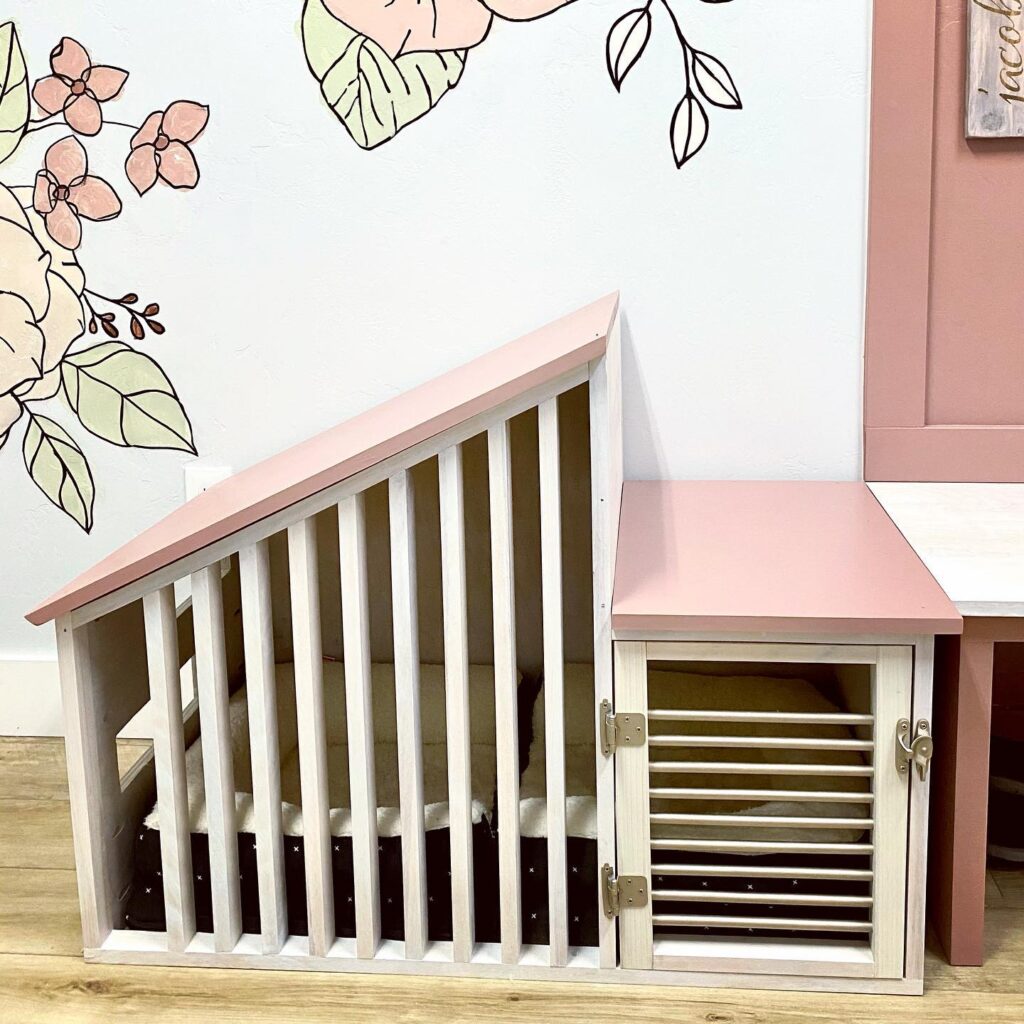
You know that moment when your golden retriever decides the couch is their couch? Like, you bought that thing. You picked the fabric. And now there’s a permanent fur dent in the cushion and drool on the armrest. Yeah. This kennel is the answer to that.
Prep Time: 1 hour | Active Project Time: 6–8 hours | Difficulty Level: Intermediate
Materials & Tools:
– 3/4-inch birch plywood sheets (for the base, roof panels, and side walls)
– 1.5-inch x 1.5-inch wood dowels or square balusters (for the vertical slats)
– Dusty rose paint or chalk paint (color-matched to your walls)
– White oak wood stain or whitewash finish
– 2 silver cabinet hinges and 1 latch lock (for the smaller nook door)
– Wood screws, wood glue, sandpaper (120-grit and 220-grit)
– Circular saw, drill, measuring tape, level
– A cozy kennel pad in cream or ivory
Instructions
Cut your plywood into two roof panels — one longer panel at roughly 24 inches and one shorter at 12 inches — to create that signature angled roofline you see in the photo. Sand every edge with 120-grit first, then finish with 220-grit so the wood feels smooth and your golden won’t snag her coat on anything.
Build the main kennel frame first using your plywood sides and base. The vertical slats go on the front face — space them about 2.5 inches apart so there’s airflow but your dog still feels tucked in and secure. That spacing means she can see you from her spot, which actually reduces anxiety in dogs who hate being fully enclosed.
Attach the angled roof panels at the top so the tall side sits at the back wall and the front dips lower. This slope isn’t just for looks — it gives your pup a cozy, den-like ceiling that feels safe without being dark or cramped.
The smaller nook on the right side is built as a separate cube frame, roughly 18 x 18 inches, with its own slatted door using the two hinges and latch. And this is where it gets fun — that little nook works as a second resting spot or a feeding station. Built-in versatility means you’re solving two problems with one build.
Paint the roof panels in your dusty rose shade. Apply two coats, letting each dry for at least 45 minutes. Whitewash the wood frame by diluting white paint 1:2 with water and brushing it on in long strokes, then wiping back with a cloth. The result is that soft, driftwood finish you see here — warm but not heavy.
Add your kennel cushion last, tucked right into the base. A non-slip pad underneath keeps the whole structure from shifting when your girl trots in and out.
Measuring twice before every cut is the kind of habit that saves you a full sheet of plywood. And if your walls are already a dusty rose or mauve tone, pulling that same color onto the kennel roof makes the whole thing read as furniture, not a cage.
📸 Photo credit: Instagram @joyinbecoming
#2: The Slatted Wood Indoor Dog Kennel That Looks Like Furniture
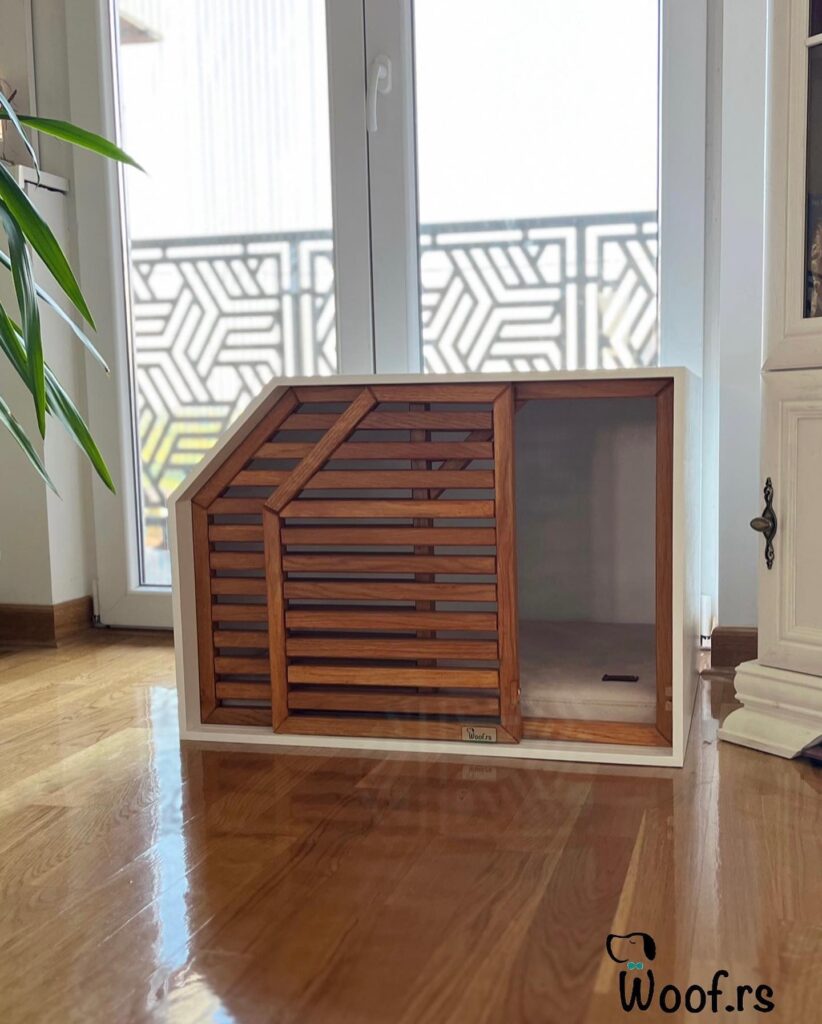
You know that moment when your golden retriever does her dramatic flop right in the middle of the living room, and her giant crate is just sitting there looking like a prison cell in your otherwise gorgeous space? Yeah. That was me every single day until I found this build.
This kennel uses a white MDF outer frame with a warm walnut-stained oak slat panel as the front facade. The angled roofline gives it that house shape without the bulk. Inside, there’s a light gray cushioned base mat that sits flush with the floor — no raised lips, no tripping hazards.
Materials & Tools
– ¾-inch MDF boards (white-painted finish)
– Oak wood strips (approximately 1-inch wide, stained walnut)
– Wood glue + brad nailer
– Miter saw for angled cuts on the roofline
– Light gray foam cushion, cut to fit interior floor
– Sandpaper (120-grit then 220-grit)
– White semi-gloss paint + walnut wood stain
Instructions
Start by cutting your MDF into five panels — two side walls, a back, a base, and the signature angled top piece. The roofline angle sits at roughly 30 degrees, so set your miter saw there and take your time with that cut because it defines the whole silhouette.
Once your box is assembled with wood glue and brad nails, sand every edge down to 220-grit smoothness. This matters more than people think — rough edges mean splinters near your dog’s face and honestly, rough edges catch dust like crazy.
Paint the entire MDF frame in white semi-gloss. Two coats minimum. While that dries, cut your oak strips to identical lengths and start laying them horizontally across the front panel, leaving a ¼-inch gap between each slat. The slatted design — horizontal oak strips on a white frame — gives you that airy, furniture-grade look and keeps the kennel from feeling claustrophobic for your dog.
Stain all oak slats in walnut before attaching them. This seals the wood and adds that rich contrast against the white frame. Attach each strip with two brad nails per end and a line of wood glue for longevity.
The open right side acts as the entry point — no door needed if your golden is crate-trained. Drop the gray foam cushion inside, and she has a cozy retreat that genuinely looks like a design piece.
Real talk: run your hand along every inner edge before your dog goes in. Any rough spot needs another pass with sandpaper. Your dog’s coat and skin will thank you.
Prep Time: 30 minutes | Active Project Time: 4–5 hours | Difficulty Level: Intermediate
If you love this style, the 12 Creative Outdoor Dog Kennel Ideas for Your Furry Friend has more builds worth bookmarking.
📸 Photo credit: Instagram @woof__rs
#3: Double Dog Kennel Furniture with Rebar Bars and a Butcher Block Top
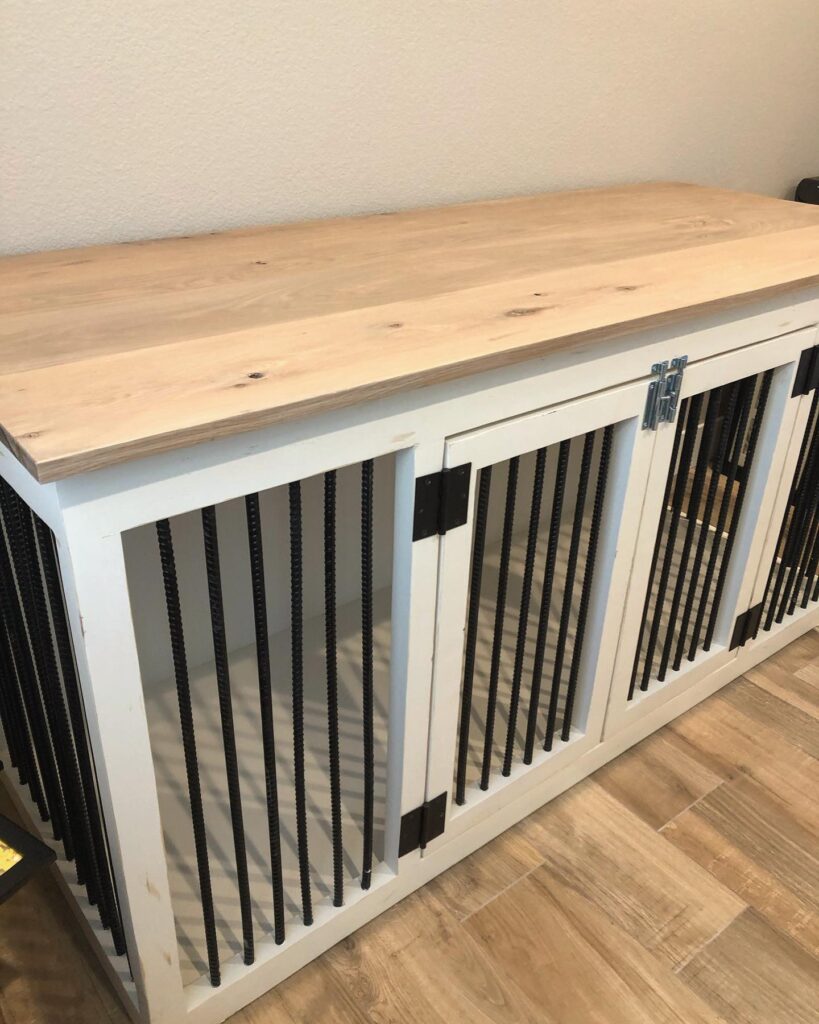
Your golden retriever has claimed the entire couch again. There’s drool on the cushions, fur on the throw pillows, and you’re two seconds away from just surrendering the living room entirely.
This double dog kennel furniture piece is the answer. It gives your pup a dedicated space while looking like something straight off your Pinterest board — white painted wood frame, black rebar spindles, and a raw butcher block top that doubles as a console table.
Materials & Tools:
– 2×4 and 1×4 pine lumber (white painted finish)
– 3/8-inch diameter rebar rods (cut to matching lengths, spray-painted matte black)
– Solid wood butcher block panel (natural, unsealed finish — approximately 60 inches x 16 inches)
– Black iron strap hinges (2 sets for double doors)
– Black barrel bolt latches
– Wood screws, wood glue, sandpaper (120 and 220 grit)
– White semi-gloss paint and primer
– Miter saw, drill, jigsaw
– Measuring tape, level, clamps
Instructions
Start by cutting your 2×4 lumber into the outer frame pieces — two long horizontal rails at 60 inches and four vertical corner posts at 24 inches tall. Sand everything with 120-grit paper before assembly. This is the key: pre-drilling your screw holes prevents the wood from splitting and keeps those white corners looking clean.
Assemble the outer box first using wood glue and 3-inch screws, clamping each joint while it dries. Once the base frame is solid, drill evenly spaced 3/8-inch holes along the top and bottom rails — space them 2.5 inches apart — to accept your rebar spindles. Slide each rebar rod through and secure with a dab of construction adhesive inside the hole. The rebar spacing gives your dog ventilation and visibility (benefit: no anxious pacing from feeling trapped), and the matte black finish won’t show nose smudges (payoff: you stop wiping the kennel down every single day).
Build the center divider the same way to create two separate bays. For the doors, frame them from 1×4 pine, add rebar spindles the same way, then hang them using your black iron strap hinges. Attach the barrel bolt latches at mid-door height.
Finish the entire wood frame with white primer, let it cure fully, then apply two coats of white semi-gloss. Set your butcher block top directly on the frame — no attachment needed if the fit is snug — or secure it from underneath with angle brackets.
Sand the butcher block with 220-grit for a silky finish, and leave it unsealed if you love that raw, natural look.
Rebar tends to have sharp cut ends — hit each one with a metal file before installing. Your dog’s nose will be right at that level.
Prep Time: 1 hour | Active Project Time: 6–8 hours | Difficulty Level: Intermediate
And if you’re already in a creative DIY mood, 12 Heartfelt Designs for DIY Dog Accessories has some really sweet ideas to pair with this build.
📸 Photo credit: Instagram @dadthebuilder
#4: The Collapsible Metal Dog Kennel That Looks Like Furniture
Okay so you know that moment when your golden bolts out of her crate and the whole wire thing just explodes across your living room floor?
Yeah. That was me every single Sunday morning.
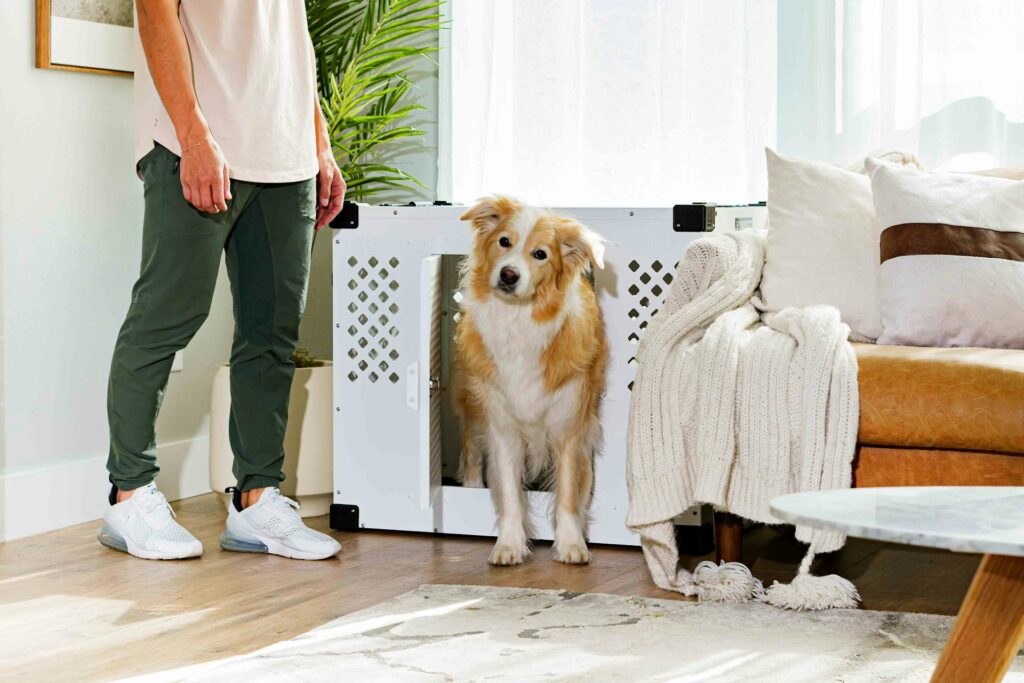
This build changed everything. It’s a white powder-coated aluminum panel kennel with diamond-cut ventilation cutouts and black heavy-duty corner brackets — and it sits next to your leather sofa like it belongs in a West Elm catalog.
Materials & Tools:
– White aluminum composite panels (cut to 24″ x 36″ for a large breed)
– Black steel corner brackets (8 total)
– Stainless steel latch hardware with lock
– Anti-scratch rubber floor feet
– Diamond-cut router bit or pre-cut ventilated panels
– Drill, measuring tape, hex screws
Instructions
Cut your panels to size first — two 24″ x 24″ side walls, one 36″ x 24″ back panel, and a 36″ x 24″ roof. Sand every edge before assembly so your girl doesn’t nick herself climbing in.
Attach the corner brackets at each joint using hex screws. The bracket system means the whole structure folds flat — folding panel design locks into rigid corners, which keeps the kennel stable during those dramatic golden retriever “I don’t wanna go in” moments, and means you’re never stuck with a bulky crate when guests come over.
Mount your latch hardware on the front opening panel last. Set the rubber feet underneath so it doesn’t slide on your hardwood.
If your golden is anything like mine, she’ll walk straight in and just… stay there. That’s exactly the peace you’ve been waiting for.
Seal any raw panel edges with white metal edge tape — it keeps moisture out and the whole thing looking clean for years.
Prep Time: 30 min | Active Project Time: 2–3 hours | Difficulty Level: Intermediate
📸 Photo credit: pexels
#5: The Furniture-Style Dog Crate That Doubles as a Side Table (And Your Golden Will Actually Love It)
You know that moment when your golden retriever’s metal wire crate is just… sitting there in your living room like an eyesore you keep meaning to hide behind a throw blanket? Yeah. My cousin had the same problem. Her dog’s crate was basically the first thing guests saw walking in. Not cute.
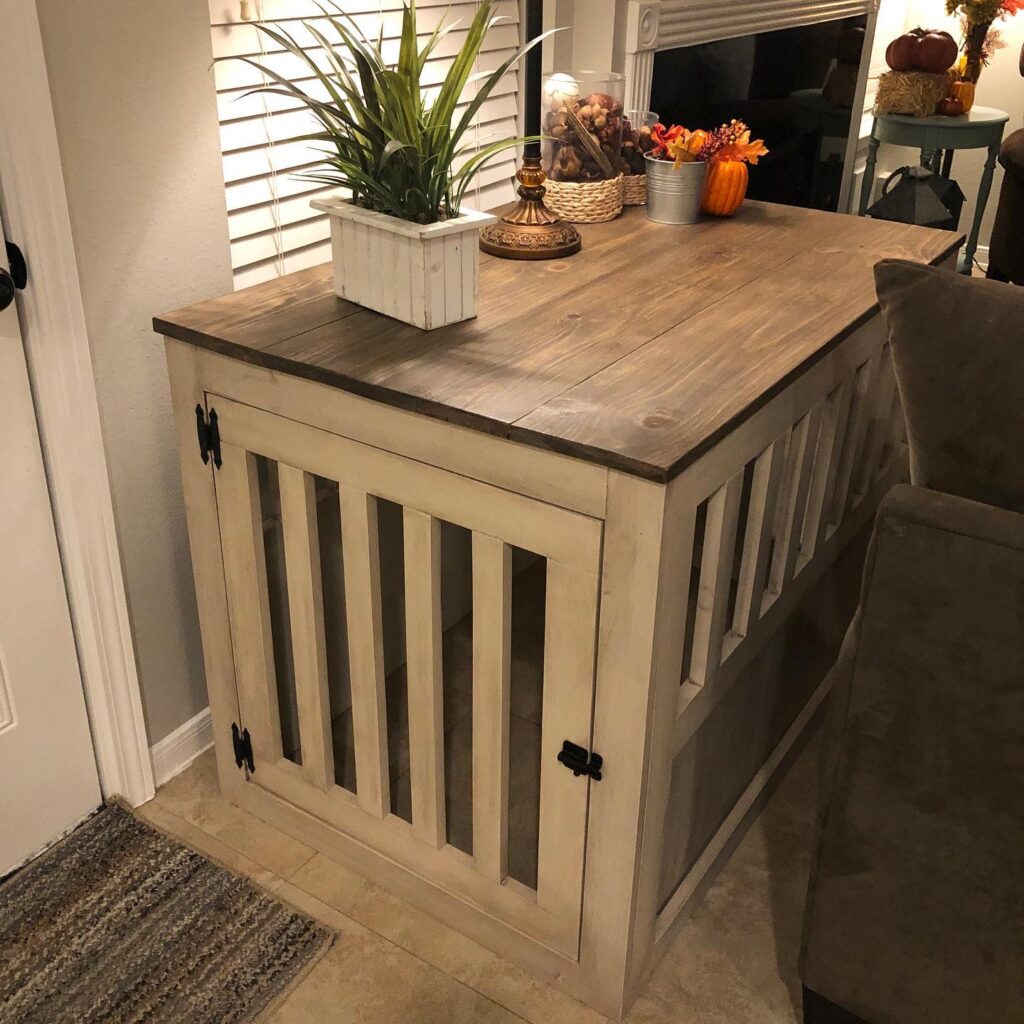
This solid wood dog kennel end table is the fix. The one in this photo uses pine wood painted in a warm cream/off-white chalk paint, topped with a dark walnut stain finish on the tabletop. The front door features vertical wood slat panels with black cast iron butterfly hinges — giving it that farmhouse-meets-Pinterest feel you’re going for.
Materials & Tools You’ll Need:
– 2×4 pine boards (frame)
– 1×3 pine boards (slats and panels)
– ¾” plywood sheet (tabletop base)
– Black butterfly hinges x4
– Black barrel bolt latch x1
– Chalk paint (off-white/cream)
– Dark walnut wood stain
– Wood screws, wood glue, sandpaper (80 & 120 grit)
– Miter saw, drill, paintbrushes
Prep Time: 30 min | Active Project Time: 6–8 hours | Difficulty Level: Intermediate
Instructions
Start by cutting your 2×4 pine boards into four vertical corner posts at 30 inches tall each. These posts form the skeleton of your crate, so take your time getting them square before you screw anything together.
Cut your 1×3 pine slat boards to 24 inches for the front door panel. Space them 2 inches apart — wide enough for your golden to see out, snug enough to feel secure. Assemble the door frame separately before attaching the hinges.
Sand everything down with 80 grit first, then finish with 120 grit. And this step matters more than people realize — chalk paint grabs onto smooth wood differently, so don’t skip the fine sanding pass.
Paint two coats of your cream chalk paint on the frame and door. Let each coat dry fully before the next. The dark walnut stain goes on the tabletop only — brush it on, let it sit for five minutes, then wipe off the excess with a clean rag.
Attach the butterfly hinges to the door frame and the front corner post using your drill. The barrel bolt latch keeps the door shut — your golden isn’t escaping this one.
Once everything is dry, lightly distress the painted edges with fine sandpaper for that farmhouse finish. The slat construction keeps airflow moving through the crate, which means your dog stays comfortable inside. And that tabletop? 36 inches wide with solid plywood underneath — sturdy enough for plants, a candle, whatever you’re styling for fall.
If you love this style and want even more options, 14 Stylish DIY Dog Crate Furniture Ideas You’ll Love has a whole lineup worth bookmarking.
Wax the painted finish with clear furniture wax after everything cures — it protects the chalk paint from dog nose smudges and keeps that creamy color looking fresh way longer than you’d expect.
📸 Photo credit: Instagram @thenerdybuilder
#6: Built-In Double Dog Kennel with Sliding Barn Doors (The One That’ll Make Your Whole Living Room Look Like a Pinterest Board)
Okay, you know that moment when your golden retriever has claimed the entire bottom shelf of your entertainment unit and you’re just… staring at the chaos? Dog hair on everything, the bed half-hanging out, and guests pretending not to notice. That was me every single weekend.
This built-in double kennel is everything.
Materials & Tools You’ll Need:
– Cedar tongue-and-groove planks (shiplap style, for interior walls)
– 1×6 pine boards for the door frames
– Black mini barn door hardware kits (sliding rail + roller wheels)
– Black iron handles and hinges
– White painted MDF for the base and top cabinet surround
– Personalized name signs (small white rectangular plaques)
– Gray faux-fur pet bed inserts
– Wood stain (warm honey-brown tone)
– Circular saw, drill, sandpaper, wood glue, nail gun
Prep Time: 2 hours | Active Project Time: 2–3 days | Difficulty Level: Intermediate
Instructions
Start by building your base frame from white-painted MDF, sizing each kennel bay to fit your dog comfortably — for a golden retriever, aim for at least 36 inches wide by 24 inches tall per bay.
Once your box frame is secured, line the interior walls with cedar shiplap planks running horizontal. This does two things: it looks stunning and the natural cedar scent keeps the space feeling fresh.
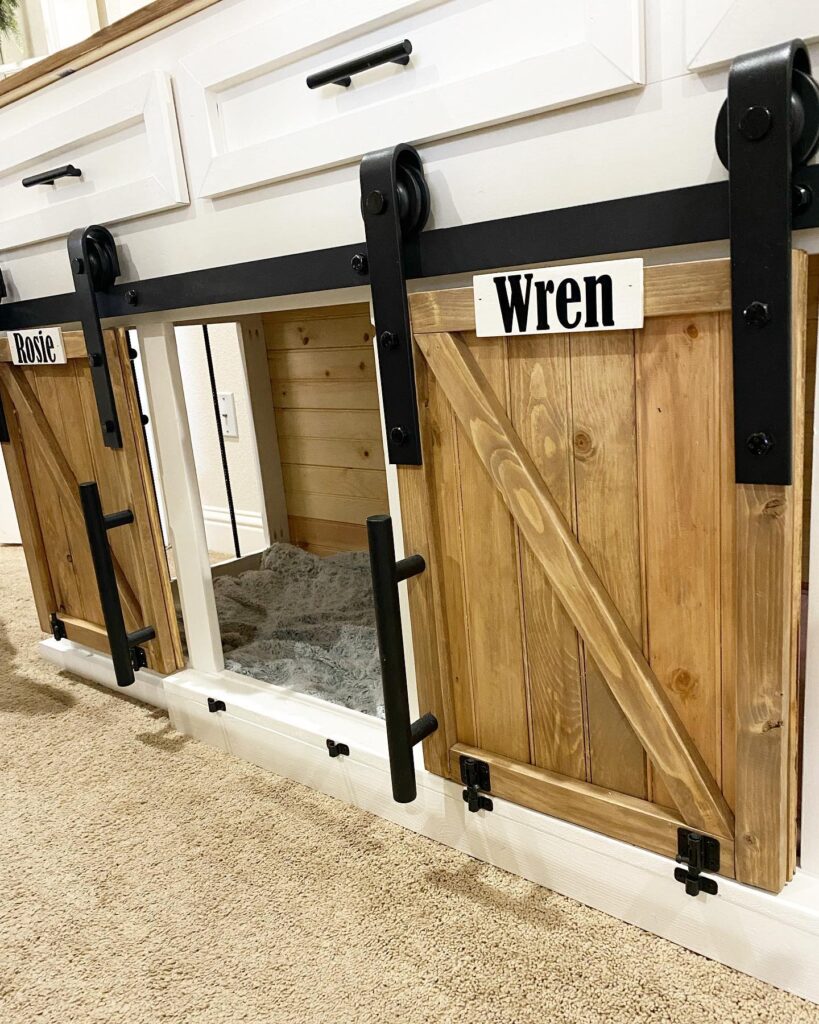
Cut your pine door panels next. Build each barn door with a classic Z-brace pattern on the front — two vertical planks with a diagonal cross piece. Sand everything smooth before staining with that warm honey tone.
Mount your black sliding barn door hardware along a single continuous rail above both openings. The roller wheels carry each door left or right, which means your golden can walk straight in without you fumbling with hinges while holding groceries.
Attach the black iron handles vertically on each door face. Add small latch hooks at the base so the doors stay shut but release easily. Slide the name signs onto the top rail area — it makes each dog feel like they have their own space, which honestly helps with territorial behavior too.
Drop in the gray faux-fur bed inserts and you’re done.
The sliding doors keep the kennel accessible but contained, the cedar interior actually stays cleaner than fabric crates, and the built-in design means you reclaim your floor space completely. Your guests will think you hired someone.
If you love this style, 7 Creative Dog Crate Topper DIY Ideas pairs perfectly with this build for the cabinet section above.
Stain your doors before attaching the hardware — trying to tape around those black rollers after the fact is a whole unnecessary headache. And if your golden is on the bigger side, add a low wooden threshold strip at the base of each opening. It keeps the bed insert from sliding out every time she comes bounding in.
📸 Photo credit: Instagram @from_sawdust_to_sprinkles
#7: The Double-Wide Dog Kennel That Looks Like a Sideboard (But Your Pup Lives Inside)
Prep Time: 2 hours | Active Project Time: 2 full weekends | Difficulty Level: Intermediate
—
Okay, you know that moment when your golden retriever finally settles down for the night but you’re staring at that plastic wire crate in your living room thinking… why does my house look like a kennel? Yeah. That feeling is exactly why this build exists.
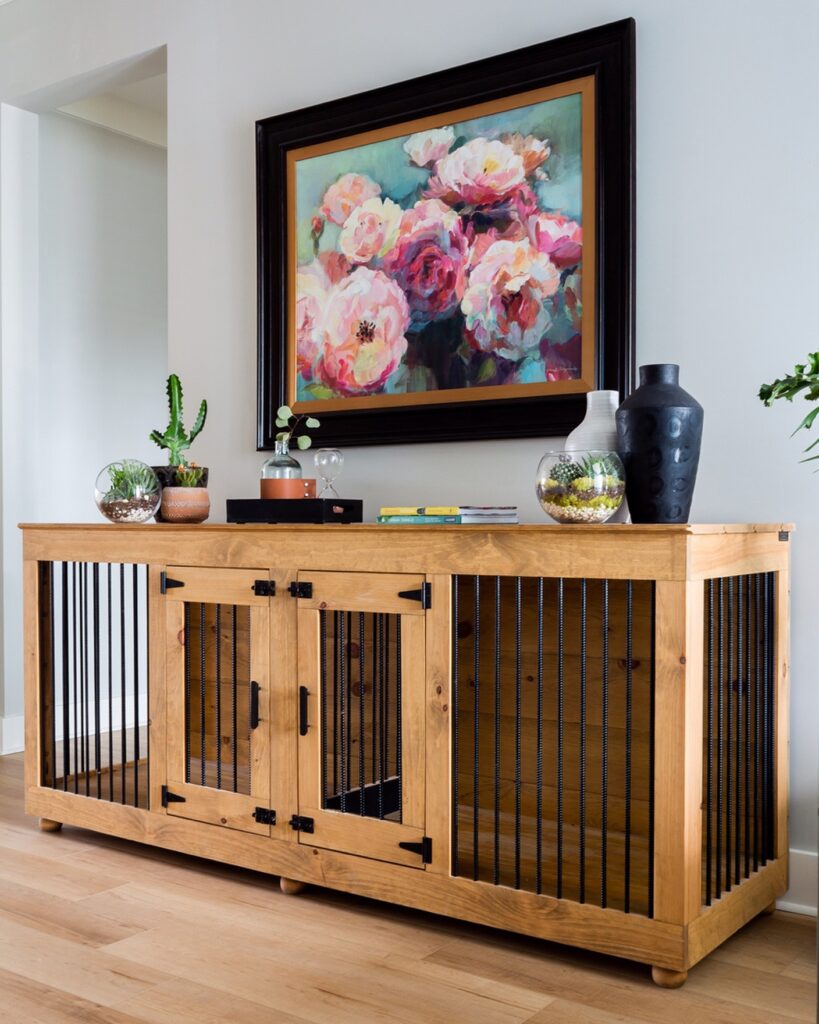
This piece is a double-bay wooden dog kennel built from knotty pine lumber with black metal rod inserts running vertically along the sides and door panels. The top functions as a full credenza-style surface — styled here with terrariums, books, and ceramic vases. It’s furniture and a dog home.
Materials & Tools
– Knotty pine boards (2x4s and 1x6s for frame and top)
– Black iron rods (½ inch diameter, cut to frame height)
– Black matte barn door hinges (2 per door)
– Black matte door handles
– Wood stain (warm honey tone)
– Bun feet (4 total)
– Drill, miter saw, pocket hole jig, sandpaper
Instructions
Start by cutting your pine boards into the frame pieces — two side panels, a back wall, a divider down the center, and a flat top. Sand everything to 120-grit before assembly. Your golden will spend hours in here, so smooth edges matter.
Use a pocket hole jig to join the frame pieces. This keeps the exterior clean with zero visible screws. Drill evenly spaced holes along the top and bottom rails of each panel to receive your iron rods — space them roughly 1.5 inches apart for visibility without escape gaps.
And here’s where it gets clever: slide the rods through the drilled holes before fully closing the frame. The rods stay locked in place by the frame tension alone — no welding, no hardware. The open rod design means your dog gets airflow and sightlines, which reduces anxiety on stressful nights.
Build your two doors using the same rod-and-frame method. Attach barn hinges and matte black handles so everything stays cohesive. The sturdy door latch — paired with solid pine framing — keeps the kennel secure, so your pup stays safe even when you’re not watching.
Attach bun feet to the base corners to lift it off the floor and give it that furniture feel. Apply your honey stain in long strokes, let dry, then seal with a matte polyurethane coat.
The flat pine top becomes your new favorite shelf. Styled right, no guest will guess there’s a 65-pound golden snoozing inside.
Measure your dog’s length plus 6 extra inches before you build — that determines your bay width. And if your golden is still a puppy, build for their adult size now so you’re not rebuilding in a year.
📸 Photo credit: Instagram @culoramegreen
The One Sizing Mistake That’ll Cost You a Full Rebuild
Okay, so here’s the thing nobody tells you before you start cutting wood — most people size their DIY kennel based on their dog’s current weight. And that sounds totally logical until your golden retriever hits 18 months and suddenly can’t turn around inside it.
I made this exact mistake with my cousin’s build. We finished it on a Saturday, stained it and everything. By spring, her dog refused to go in. Full rebuild. Don’t be us.
The pro move? Measure your dog’s full adult length — nose to tail base — then add 12 inches minimum to that number for both the length AND width. Golden retrievers especially need that extra breathing room because they’re big, fluffy, dramatic creatures who like to flop sideways.
Small change, big win: build the door frame two inches taller than you think you need. Dogs are awkward. They bonk their heads going in, then refuse the space forever.
Also, if your setup lives outdoors, pair it with a DIY dog washing station nearby — muddy paws after kennel time is a whole situation.
Your Golden Deserves a Spot That Doesn’t Wreck Your Whole Aesthetic
Pick one idea and just start. Seriously, don’t overthink it. Even a simple dedicated corner with a cozy bed and a basket for toys makes a huge difference — for you and for her.
I redid my living room setup in one afternoon and honestly couldn’t believe how much calmer the whole space felt. Less chaos, less tripping over chew toys, more “okay this actually looks cute.”
And hey, if you’re feeling inspired, DIY dog feeding station ideas are such a fun next step — super simple and so satisfying to pull off.
So tell me — which spot in your home are you claiming for your girl first?